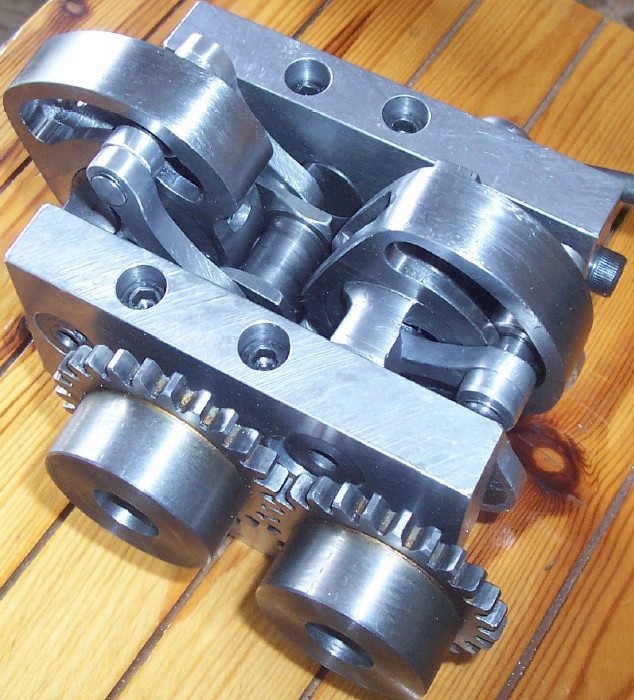
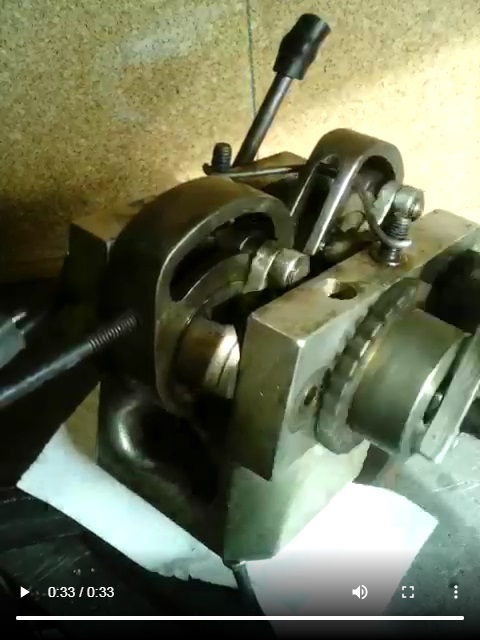
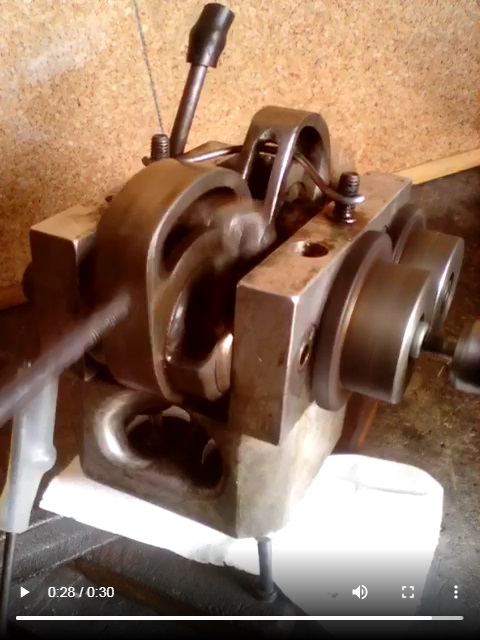
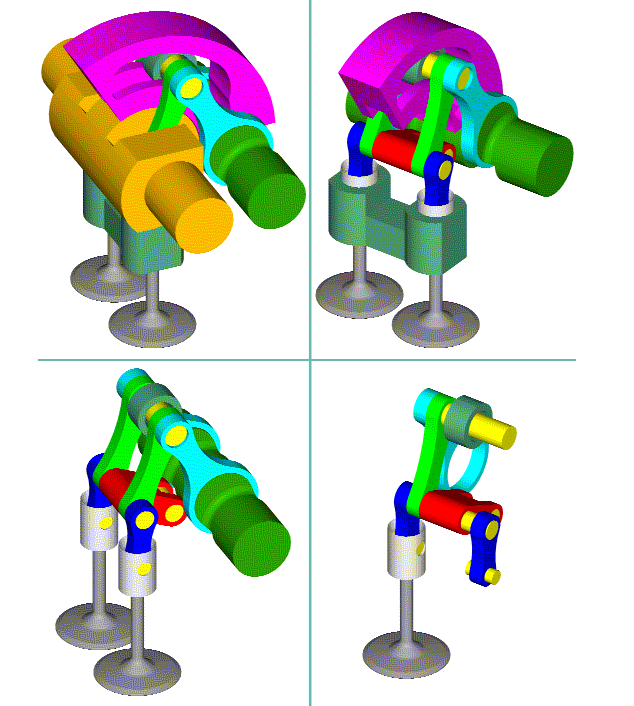
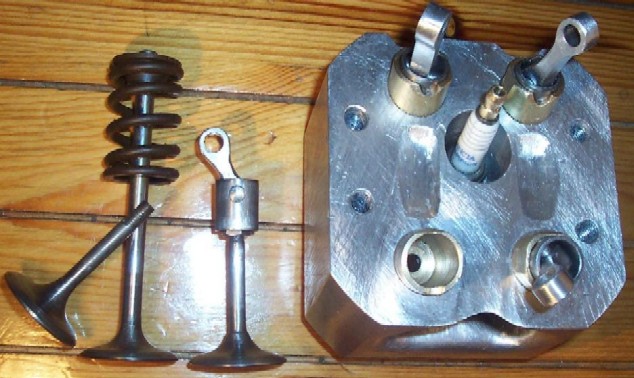
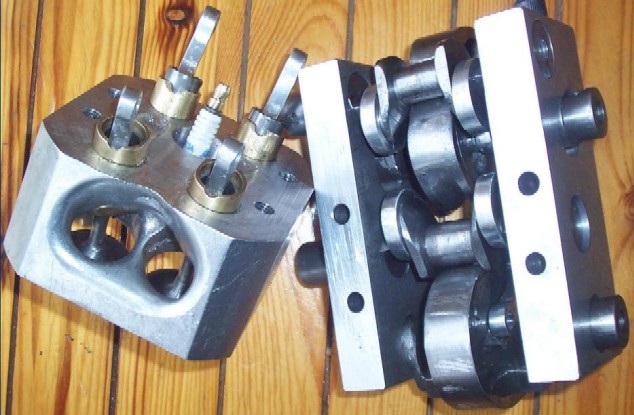
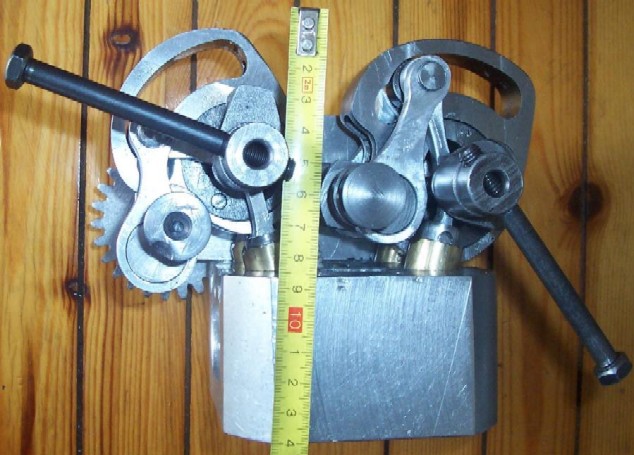
The first DVVA prototype (case with two "camshafts").
It is a fully variable Desmodromic VVA system.
Click on the following image for a demo video:
Click on the following image for another demo video:
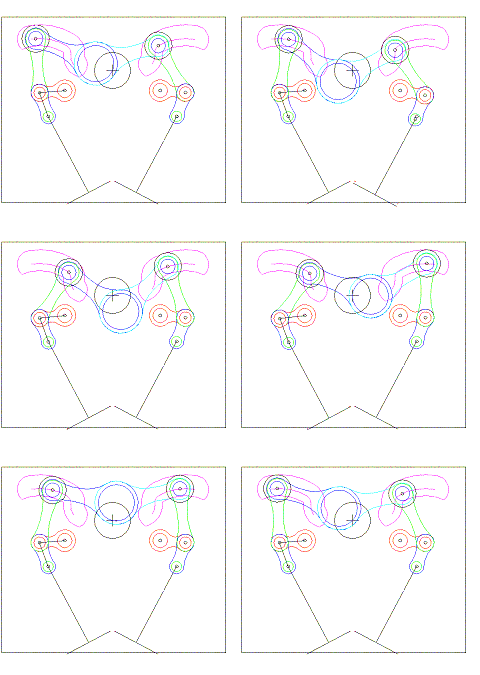
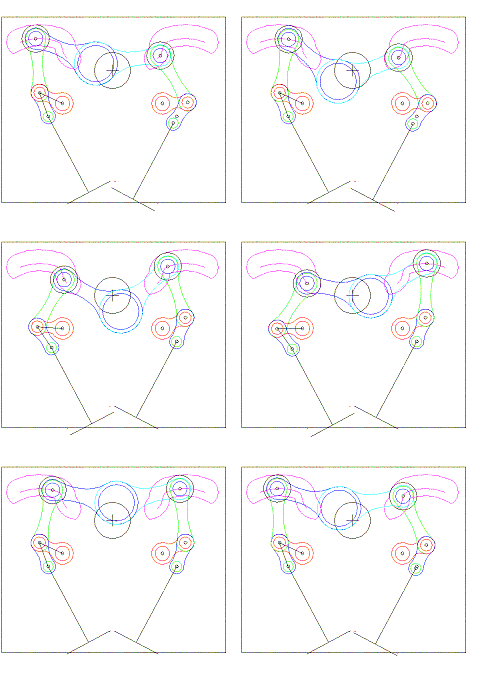
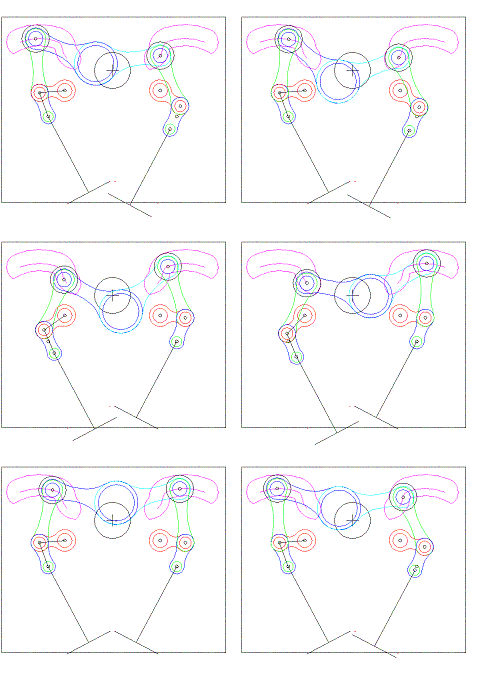
In the following three animations there is only one "camshaft" (actually a shaft with eccentric pins or crankshaft) for the opening AND the closing of all valves (intake valves and exhaust valves).
Top: the two "Lost Motion Control Shafts" (each having a track or groove or slot -magenta- along which the yoke roller and its pin roll, being in simultaneous abutment to both sides/surfaces/walls of the track) are at angles providing short duration and negative overlap.
Middle: the Lost Motion Control Shafts are at angles providing long duration, while the Constant Duration Control Shafts (they displace the pin of the big end of the red rods) are at angles providing medium valve lift. Here the angular overlap is long while the actual overlap (valve-time area) is medium.
Bottom: the Lost Motion Control Shafts are at angles providing long duration, while the Constant Duration Control Shafts are at angles providing high valve lift. The angular overlap is long. The actual overlap (valve-time area) is extreme.
The external ring (yoke) of the roller rolls along the upper surface of the track and has nothing to do with the lower surface of the track; similarly the pin of the roller rolls along the lower surface of the track and has nothing to do with the upper surface of the track. This way there is no "sliding" friction in the mechanism. The proper dimensioning of the track defines the preloading of the roller / track assembly.
The Lost Motion Control Shaft and the Constant Duration Control Shaft modify the action coming from the eccentric pin into a controllable valve lift profile.
There is neither need of valve springs nor of any other restoring spring. This, in turn, allows significantly shorter, stronger and lighter valves, lower height of the cylinder head and shorter length of the timing belt/chain.
All rods of the linkage are rid of bending loads.
The absence of valve springs leads to less friction and wear.
The valve lift profile is defined by the groove's profile and by the geometry of the linkage.
Comparing the state of the art Desmodromic Valve Train (current winner of the motoGP) with the "single mode" DVVA, the latter:
is rid of "complementary" long periphery restoring camlobes,
is rid of quick moving parts loaded in bending,
is rid of sliding friction,
has shorter and lighter valves due to the arrangement of the valve guides and due to the absence of side loads on the valve stems,
enabling higher revs, more power and adaptability to the existing conditions of operation (flat torque, better response, low fuel consumption, clean exhaust etc).
The DVVA can approach the available valve lift profiles of any existing valve train (conventional, VVA or Desmodromic). So, there is no reason for not being (the DVVA) more fuel efficient and for not providing top power.
Rid of valve springs, rid of unnecessary loads (like the restoring force from the valve springs at medium and low revs), rid of heavy quick moving parts, rid of sliding friction etc, the reliable rev limit of the engine is no longer set by the valve train but by the underneath mechanism (crankshaft, connecting rods, pistons and block).
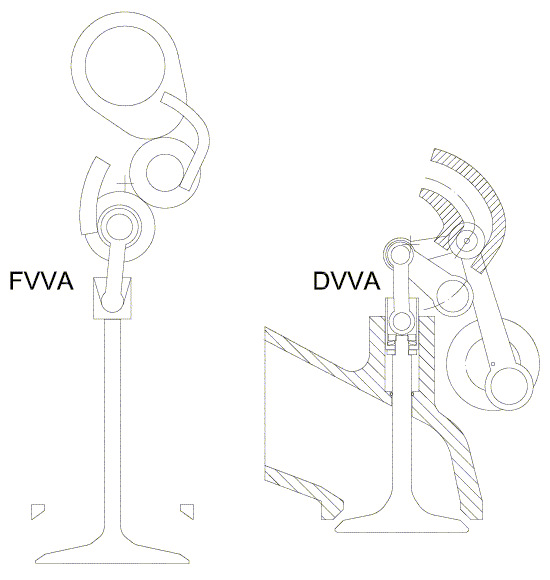
Comparing the DVVA with the FVVA
At left is a FVVA or Fully Variable Valve Actuation mechanism. It needs valve springs to restore the valves at their rest position,
it also needs restoring springs for some parts of the FVVA mechanism.
At
right is a Desmodromic (from the Greek words "desmos", meaning "tie", and
"dromos", meaning "road"/"track"/"path") Fully Variable Valve Actuation
system or DVVA. The DVVA needs neither valve springs, nor other kind of restoring
springs. The DVVA is as Desmodromic as Ducati's valve train systems for normal and
racing moto engines. And, at the same time, the DVVA is infinite times more variable than the state of the art Variable Valve Actuation systems, like BMW's valvetronic, Nissan's VVEL, Honda's A-VTEC etc (see Pattakon's FVVA
system).
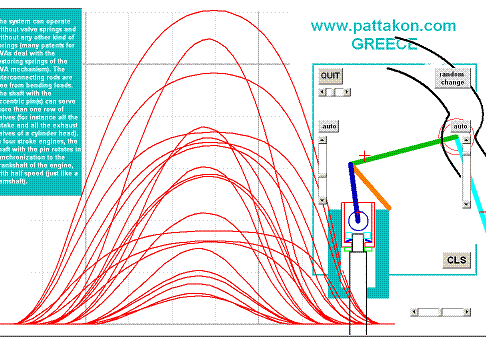
To learn more and 'play' with DVVA's capabilities, download and run the program 'DVVA1.exe' (95 KB) by clicking on the
image:
The 'DVVA1.exe' shows animated a Desmodromic Fully
Variable Valve Actuation mechanism, and computes and presents graphically the
valve lift profile according the desirable / selected angles of the two control
shafts.
Locking (at an angle) the control shaft that holds the roller, the system "degrades" down to a Desmodromic Constant Duration VVA (suitable for applications where the simplified direct control and the instant response are mandatory, like in motoGP).
Locking (at an angle) the other control shaft, the system "degrades" down to a Desmodromic Lost Motion VVA.
Locking both control shafts, the system degrades down to a single-mode Desmodromic valve train(like Ducati's Desmo).
Without springs of any kind and without camshafts, the DVVA
can operate reliably at extreme revs for racing use, like motoGP and Formula1,
and at the same time the DVVA, compared to the state of the art VVAs and to the
conventional valve train systems, increases the fuel economy and reduces the pollution,
being more driver friendly and pleasant.
DVVA principle
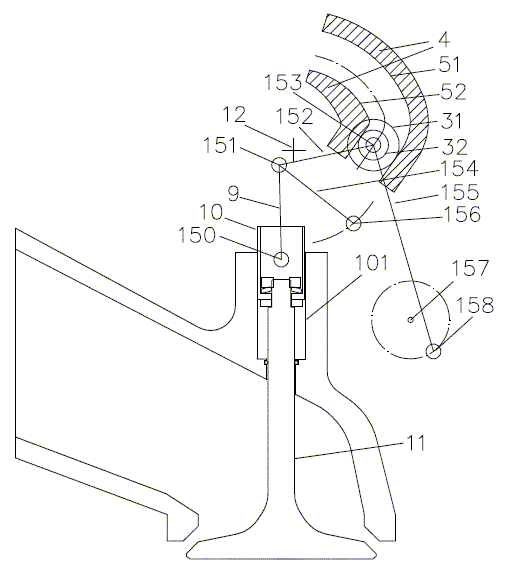
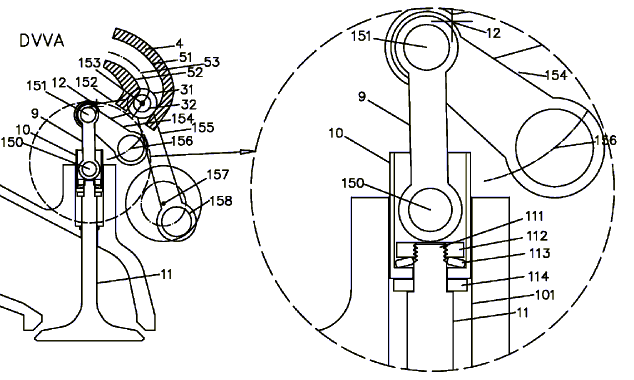
The two figures below show a cylinder head with a valve 11 slidably located in a valve guide. The valve 11 comprises a valve stem and a valve head, the latter being arranged to engage against a valve seat to close a port. A valve actuator 10 is slidably fitted in a guide 101. Means, like nut 112, lash adjustment washer 114 and elastic washer 113 are also provided to accommodate the valve lash adjustment and the thermal expansion and to assure the sealing of the valve against its seat when the valve is closed.
A track 4 is provided having a lost motion portion and an actuation portion. Track 4 is pivotally mounted about a pivot at 12. A first link 9 is pivotally mounted at one end about a pivot 150 on the valve actuator 10. The link 9 is pivotally mounted at its other end about a pivot 151.
A second link 154 is pivotally mounted at one end about the pivot 151. The link 154 is pivotally mounted at its other end to a pivot 156.
A third link 152 is pivotally mounted at one end about the pivot 151. At the other end of the link 152 is mounted a drive pin 31-32, the drive pin 31-32 engaging in the track 4. The separation between the drive pin 31-32 and the pivot 151 is equal to the radius of the lost motion portion of the track 4, and when the valve 11 is closed, the pivot 151 is located at 12 such that the drive pin 31-32 will move freely around the lost motion portion of the track 4.
A crankshaft 157 has a crank 158 thereon; the crank 158, via a fourth link 155, displaces the drive pin 31-32 along the track 4.
Rotation of the crankshaft 157, which may be driven in suitable manner from the engine, will thus cause the linkage 155, 152 to oscillate causing drive pin 31-32 to reciprocate along the track 4. While the pin 31-32 engages the lost motion portion of track 4, the valve will remain closed. However, when the pin engages the actuation portion of the track 4, it causes the linkage 154, 9 to oscillate causing valve 11 to open positively and to close positively.
The opening and closing point of the valve 11 will correspond to when the drive pin 31-32 will pass from the lost motion portion of track 4 to the actuation portion of track 4 and from the actuation portion of the track 4 back to the lost motion portion of track 4. The angular displacement of the track 4 about 12 changes the opening and closing point of the valve and provides variable valve duration from a maximum to even zero if desirable.
The angular displacement of the pivot 156 about 12 changes the valve lift and provides variable valve lift from a maximum to even zero, if desirable.
This way the system is fully variable, i.e. after selecting the desirable valve duration by proper angular displacement of the track 4 about 12, the angular displacement of the pivot 156 about 12 changes continuously the valve lift without affecting the valve duration, i.e. the system can change independently the valve lift and the valve duration.
The necessarily heavy track 4 moves only when a different valve duration is desirable. This way the track 4, which is the heaviest part of the mechanism, stays substantially immovable during an engine cycle.
To achieve reliable, low friction, high accuracy operation of the valve train at high revs, the mechanism does not involve heavy parts, like track 4, that move or reciprocate at valve revs.
The valve stem is free of bending loads.
The valve lash adjustment is either mechanical or hydraulic.
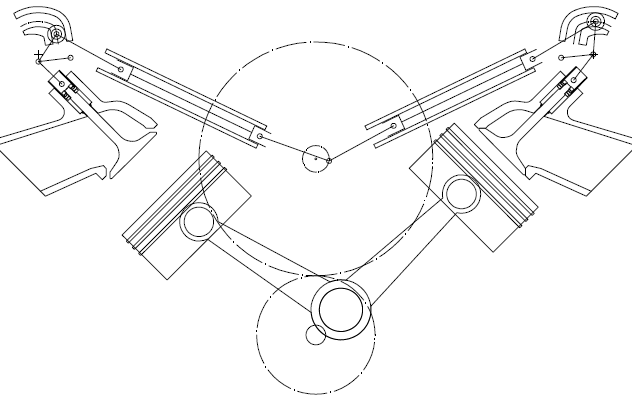
The application of the DVVA on a V-8 (or on a side cam engine, in general):
Below it is another application of the DVVA on side-cam engines (like Harley V-2, American V8 etc).
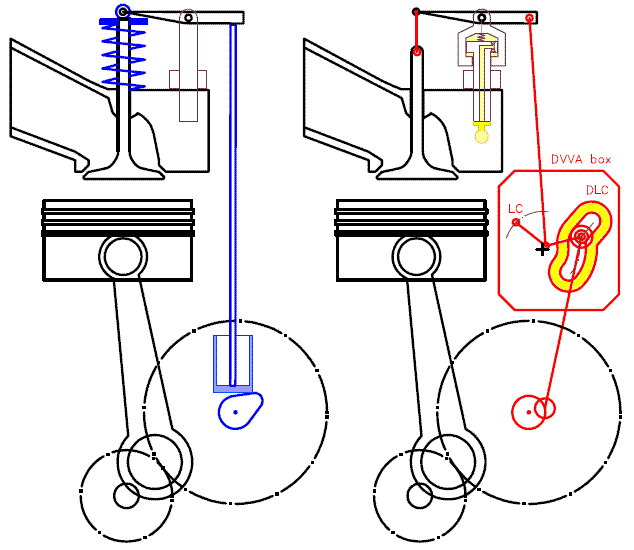
At left it is shown the conventional mechanism (constant duration, constant lift, camshaft, valve restoring spring).
At right it is shown the modified-to-desmodromic mechanism: the duration is selected by rotating, about the cross, the DLC track; then the lift is aligned by rotating, about the same cross, the LC pin:
The rocker-arm pivot of the DVVA embodies the hydraulic lash adjuster.
The following photos are from the DVVA demonstration prototype.
It is for a 87mm bore cylinder.
35mm intake valve diameter.
30mm exhaust valve diameter.
Intake valve lift from 0 to 14mm continuously variable.
Exhaust valve lift from 0 to 12mm continuously variable.
Independently variable duration from 0 degrees to a maximum.
Total height 140mm.
Focus on the short valve stem. Focus also on the long valve stroke relative to the cylinder head height.