DVVA: mechanical Desmodromic VVA HyDesmo: Hydraulic Desmodromic VVA PatAir: ElectroHydraulic Variable Valve Actuation Variable Valve Actuation Rod version Roller version Rod-Roller version More VVAs Opposed Piston Engines OPRE engine Portable Flyer PatOP engine PatPOC engine Port-Less Two-Stroke PatPortLess engine PatMar(ine) engine Variable Compression Ratio (VCR) Head-Block version Rack Gear version Crankshaft version Rotary Engine / Pump Pulling Piston Engine Other Topics Teaching Stereoscopy Crankless engine Expo Key Advantages Contact

Electro-Hydraulic Variable Valve Actuation

The state-of-the-art Electro-Hydraulic VVA is the MultiAir / TwinAir of Fiat (or UniAir of Schaeffler - INA), currently in mass production (Alfa Romeo Mito and Giulietta, Fiat Punto and Fiat 500 TwinAir, etc).

Click here to download the 170KB PatAir.exe program.
After opening the program press a few times the SpaceBar key for instructions.
The solenoid valve timing can change, the rpm can change, the resulting valve lift
profile is shown, the valve-time area is shown, etc.

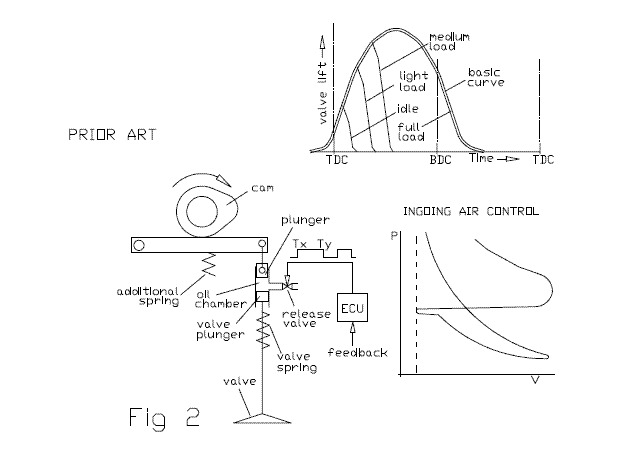
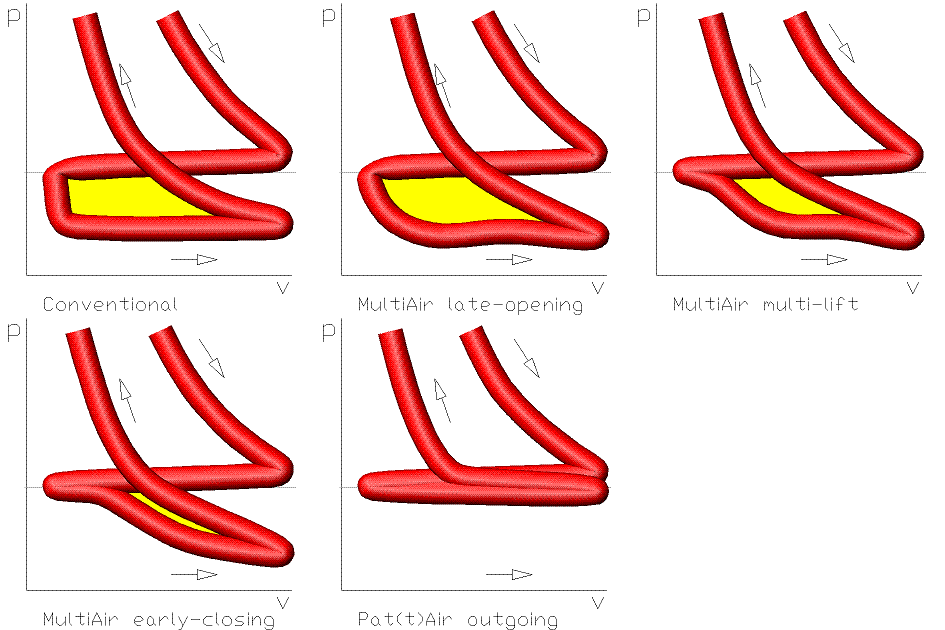
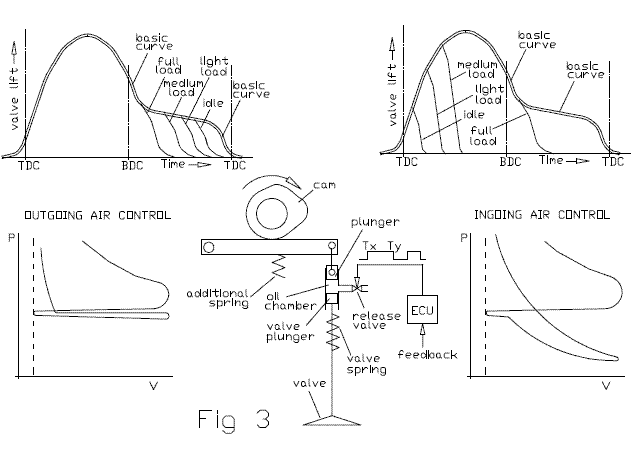
The MultiAir of Fiat works according the "Ingoing Air Control": The sooner the intake valve closes, the more "ingoing air" is kept from entering the cylinder during the suction. The later the intake valve closes, the heavier the load.

The MultiAir mechanism:
An "oil push rod" is interposed between the valve and the cam.
The cam pushes the "oil push rod" and the "oil push rod" pushes the valve.
At the right moment a solenoid valve opens, the "oil push rod" collapses and the valve closes under the restoring action of the valve spring.
By a "hydraulic braking mechanism" the landing of the valve on the valve seat becomes acceptably smooth.

The application of the MultiAir / TwinAir in mass production engines proves that the state-of-the-art solenoid valves and the hydraulic system do operate reliably and efficiently.

Things can improve.

The "Ingoing Air Control" (MultiAir / TwinAir) has some inbuilt disadvantages.

After the intake valve closing, the piston continues to move towards the BDC. The charge (air or mixture) inside the cylinder undergoes an expansion. The expansion causes the charge temperature to drop increasing the heat absorption from the hotter walls (cylinder, piston crown, cylinder head, intake and exhaust valves). After the BDC the piston compresses a hotter charge and restores less mechanical energy than the mechanical energy consumed to expand the charge.

That is, pure mechanical energy (yellow) from the crankshaft-flywheel is consumed inside the cylinder, with only result the increase of the charge temperature. The lighter the load, the bigger this "mechanical energy loss" and the higher the temperature of the cycle. The lighter the load, the more "expensive" the mechanical energy consumed, because it was generated at high BSFC.

The early closing of the intake valve leaves more time to the charge turbulence and swirl to fade before the combustion. The slower the combustion, the less efficient and the less clean the operation of the engine.


The PatAir system
The PatAir system operates either according the pattakon "Outgoing Air Control", or according the Fiat MultiAir / TwinAir "Ingoing Air Control".

According the "Outgoing Air Control" pattakon cycle, the later the intake valve closes, the more "outgoing" air is left to escape from the cylinder back to the intake manifold as the piston moves towards TDC (compression stroke). The engine of Toyota Prius (Atkinson/Miller cycle, overexpansion) operates in a limited "Outgoing Air Control" cycle.
The MultiAir principle above, and the PatAir principle below.

In the "Outgoing Air Control" cycle the vacuum into the cylinder (bad for the pumping energy and worse for the cycle temperatures and efficiency) is avoided.
The retarded closing of the intake valve leaves less time to the charge turbulence and swirl to fade before the combustion, so that the combustion is faster (good for the efficiency and better for the clean exhaust).
The improved homogeny of the charge, because the charge enters and leaves the cylinder a couple of times before it gets burned, further improves the combustion quality.

Thermodynamically the pattakon cycle (Outgoing Air Control) is different than the MultiAir Fiat (Ingoing Air Control) cycle.
The set of the available PatAir modes is a super-set of the available Fiat MultiAir / TwinAir modes: the PatAir can do everything the MultiAir / TwinAir does, and more.

In order to upgrade an existing MultiAir / TwinAir engine up to a PatAir engine, all it takes is a different intake camlobe profile (by machining, for instance, the existing camshaft) and a reprogramming of the "electronic control unit"/ECU. Then the engine can choose between the original MultiAir Fiat cycle and the PatAir pattakon cycle.

Since neither the long duration intake camlobes of the PatAir adds any cost, at all, nor the ECU reprogramming adds any cost, at all, to double the available modes of the MultiAir / TwinAir of Fiat has no manufacturing cost, at all.

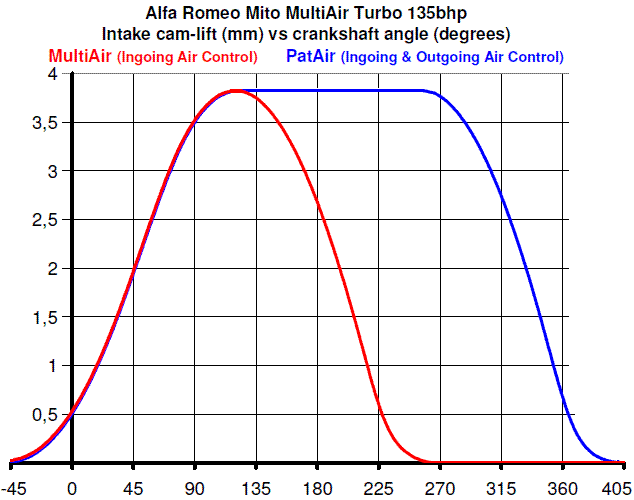
The following plot shows the cam-lift vs the crankshaft-angle of the 1st PatAir prototype (blue curve) and of the Original MultiAir engine:


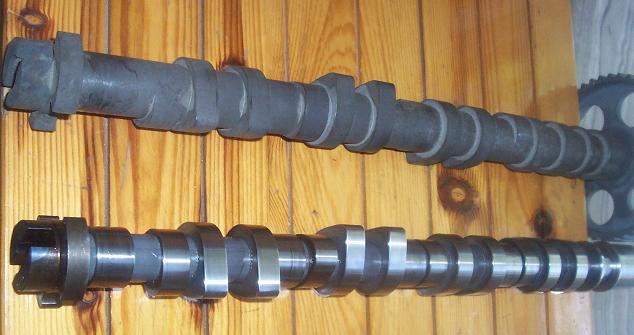
The MultiAir camshaft and the PatAir camshaft (the dark one):


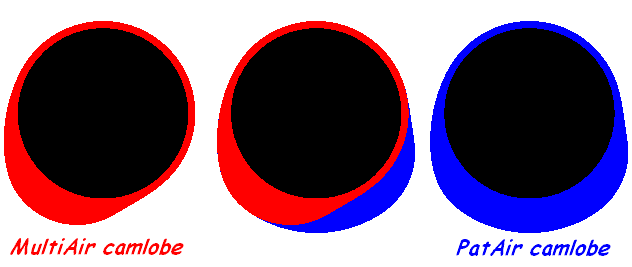
The intake camlobe profiles of the Mito MultiAir and of the Mito PatAir are shown below.
The opening camlobe profile of the PatAir and of the MultiAir are identical; also the closing camlobe profiles are identical; but between the opening camlobe profile and the closing camlobe profile of the PatAir it has been added a constant-lift lobe which, in this case, is of 136 degrees.

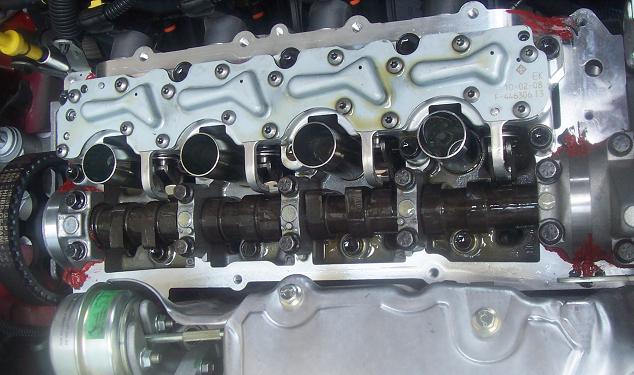
The PatAir camshaft assembled into the cylinder head


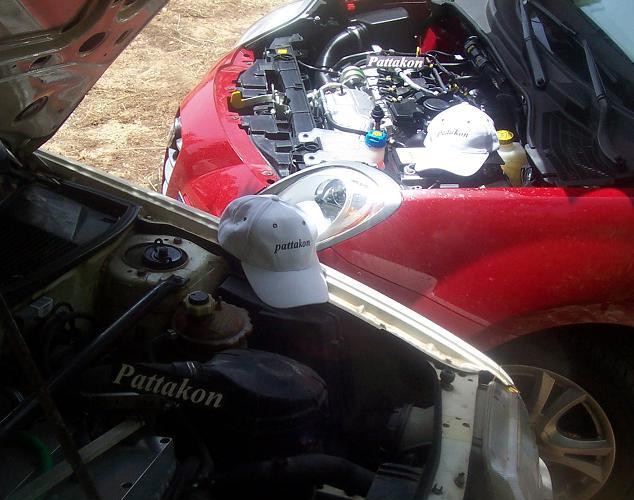
of the Alfa Romeo Mito pattakon prototype shown, below, at the side of the 1st pattakon prototype car Renault-19 VVA:


The replacement of the camshaft is the only necessary hardware modification.
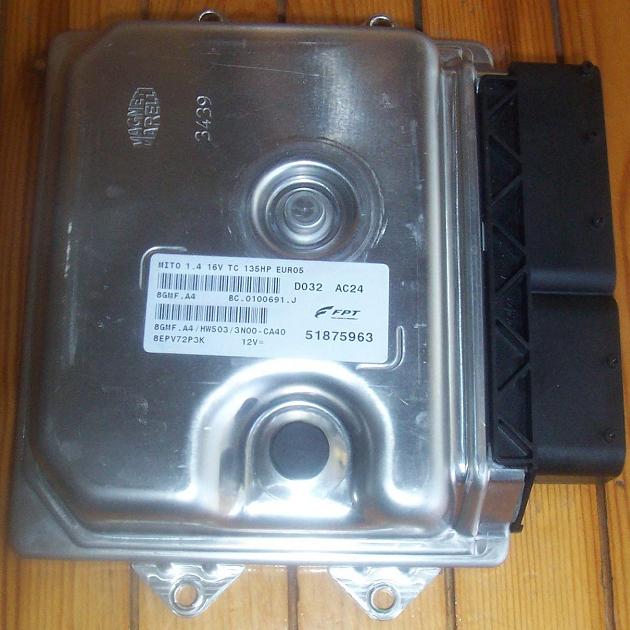
The reprogramming of the original ECU:

is the rest modification.


Things can further improve.

The "oil push rod" interposed between the cam and the valve of the MultiAir (and of the PatAir) softens (smooth down) the actual intake-valve-opening-profile and increases the inertia of the valve assembly (oil, oil plungers, additional springs etc) during the opening of the valve.
For normal engines this is a reasonable compromise.
Still, for high performance engines (super cars, racing cars, sport cars, motorcycles etc) the mechanical opening (crispy opening) of the intake valves is a must, as well as the small inertia.

The sensitivity to oil leakage and to oil viscosity is also a problem.

Besides, in order to control an exhaust valve, the hydraulic system of the Fiat MultiAir (and of the pattakon PatAir) is subjected to far heavier loads during the exhaust valve opening (because of the in-cylinder pressure just before the exhaust valve opening). Things get worse in case of supercharging.


The PattAir system
The PattAir (with double "t") system of pattakon resembles to, but is different than, the MultiAir and the PatAir systems.

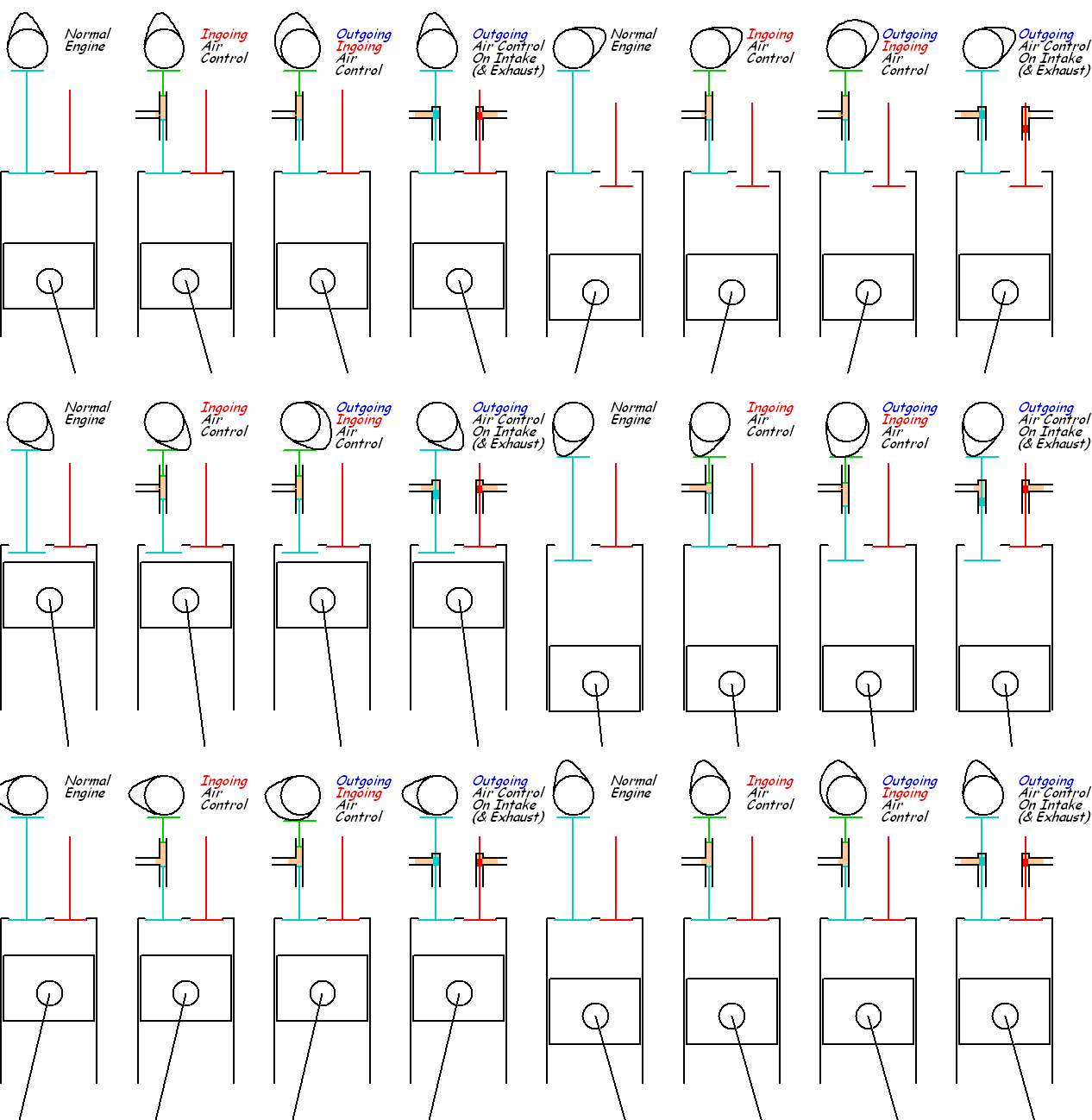
Above: the PattAir principle versus the MultiAir (prior art) principle.

Click here to download the stereoscopic animation PattAirRocker.exe (7.2MB).
A PattAir Upgrade-Kit applied on a conventional finger-follower valve train system.
After opening the animation move the mouse around the screen to align the rhythm,
press the SpaceBar key a few times, use the dot (.) the comma (,) and the slash (/) keys.
Double click the window to quit animation.

The valve opens true mechanically (there is no "oil push rod" interposed between the cam and the valve). The opening ramp is as wild (crispy) as in the conventional engines. Only during the valve closing the hydraulic system gets into play and delays controllably the valve closing.
The engine operates according the "Outgoing Air Control" cycle.

If desirable, the PattAir can control the exhaust valves without overstressing the hydraulic system, because the tough work of the initial exhaust-valve-opening is done mechanically.

In the PattAir the hydraulic system acts like a brake or damper (and not like a transporter of mechanical action between the cam and the valve, as it is the case in the MultiAir and in the PatAir). During the valve opening, the "damper" fills up with oil and does not add inertia to the valve opening mechanism. During the valve closing the "damper" resists to the valve-restoring- motion until a solenoid valve opens allowing the oil to escape from the damper and the valve to close.

As the valve approaches the valve seat, the port area, through which the oil escapes from the damper, reduces progressively, because the plunger covers it progressively, enabling the smooth landing of the valve onto the valve seat at all operational conditions. That is, the smooth landing of the valve is an inbuilt characteristic of the PattAir (no need for additional parts / complication).


Click here to download the stereoscopic animation PattAirBucket.exe (8MB).
A PattAir Upgrade-Kit as applied on a conventional bucket-lifter valve train.
After opening the animation press a few times the SpaceBar key for details.
Use the dot (.) slash (/) and comma (,) keys. DoubleClick to quit animation.

In the Pattair the brake or damper can operate with considerably shorter lift than the maximum valve lift, which is important for both: the safety of the system and the high revving capacity of the engine. For instance in an engine wherein the valves can stay permanently open for 5mm without hitting the piston (valve-pockets on the piston crown), the damper can keep open the valves at 5mm for as long as necessary without safety problem, even in case of mechanical, hydraulic or electrical malfunction.
Besides, the camshaft recovers more energy from the compressed valve springs: the damper gets into play at medium low valve lifts, wherein the valve spring force is a couple of times weaker.

Optionally, the PattAir using just one solenoid valve can control all the four cylinders of a four-inline conventional engine, with each cylinder independently controlled (i.e. with the single solenoid valve timing being aligned by the ECU independently for each cylinder). This arrangement resembles to the "common rail" (something like "time sharing" of the solenoid valve among the four cylinders).

This technique fits even better to the twin cylinder (not the four inline) Fiat MultiAir engine with the 360 degrees crankpins: it can function according the MultiAir cycle with only one solenoid valve to control independently both cylinders.

On the other hand, each valve can have its own solenoid valve (for controllable turbulence and swirl, for instance, or for high performance engines wherein the minimization of the oil circuit elasticity and of the working oil inertia is critical).

The cranking of the engine takes a few times less torque than the conventional and the MultiAir engines of same capacity, i.e. the PattAir and the PatAir systems need a few times smaller starter and battery (and start-stop system, if any). The manual cranking is also an option, especially for the motorcycle engines (because the "Outgoing Air Control" also serves as an efficient de-compressor during the cranking).

If desirable, the EGR (Exhaust Gas Recirculation) can be controlled by the PattAir applied on the exhaust valves: the controllable advancing of the exhaust-valve-closing before the TDC (during exhaust stroke) enables a controllable amount of hot exhaust gas to remain into the cylinder for the next cycle of operation.
Furthermore, the PattAir can control the load (or the actual compression) of a direct injection engine by acting exclusively on the exhaust valves: opening the exhaust valves after the BDC (compression stroke) a part of the air that entered into the cylinder escapes to the exhaust. In this case the camlobe profile of the exhaust valve can have a conventional exhaust cam (for the exhaust of the gas after combustion) and a secondary exhaust cam (for the control of the quantity of air trapped into the cylinder before the compression, according the "Outgoing Air Control"). The exhaust valves and the cylinder are "internally" cooled, the charge is cooler at the beginning of the actual compression, the intake manifold is cooler, there is no reciprocation of air between the intake manifold and the cylinder, etc.
I.e. with the PattAir exlussively on the exhaust valves of a direct injection engine, both the EGR and the load (or actual compression ratio) can be accurately and effectively controlled, independently on each cylinder, without overstressing the hydraulic circuit.

Click here to download the PattAir.wmv video-animation (3.0 MB)


Below is an application of the PattAir on a V-8 engine. The space into the "Vee" is more than adequate for the mechanism and the solenoid valves (not shown). The new bucket lifter (cyan) form, together with the bucket-lifter-guide (blue), an oil chamber / damper. The small green cylinder between the push rod and the bucket lifter, is the hydraulic (or mechanical) lash adjuster. The throttle valve is not necessary any longer.

Below is an application of the PattAir on a B16A VTEC engine. The VTEC is disengaged. The multi-piece heavy rocker arm (left) is replaced by a light alloy single piece rocker arm with needle-roller-bearing cam follower. The existing "niche", where the restoring spring of the middle rocker of the original VTEC is nested, is now used for the oil chamber (cyan). The oil plunger (blue) follows the motion of the rocker arm by means of a small connecting-rod (green) and needs not a restoring spring. Depending on the timing of the solenoid valve (not shown), the valves can stay open for as long as necessary to allow to a controllable quantity of charge to return to the intake manifold. The exhaust valves can similarly be controlled. At high revving / full load, the hydraulic system is disengaged. A throttle valve is optional.

Things can further improve.

The combination of the "Outgoing Air Control" cycle (breathing optimization, turbulence and swirl optimization, pumping loss minimization) with the Variable Compression Ratio (combustion optimization, emissions control) makes the state-of-the-art internal combustion engine a true Variable Capacity Engine (VCE) that operates permanently at the top/optimum thermal efficiency whatever the load and the revs are, thereby leaving no room to the hybrid technology.


pattakon Home Page