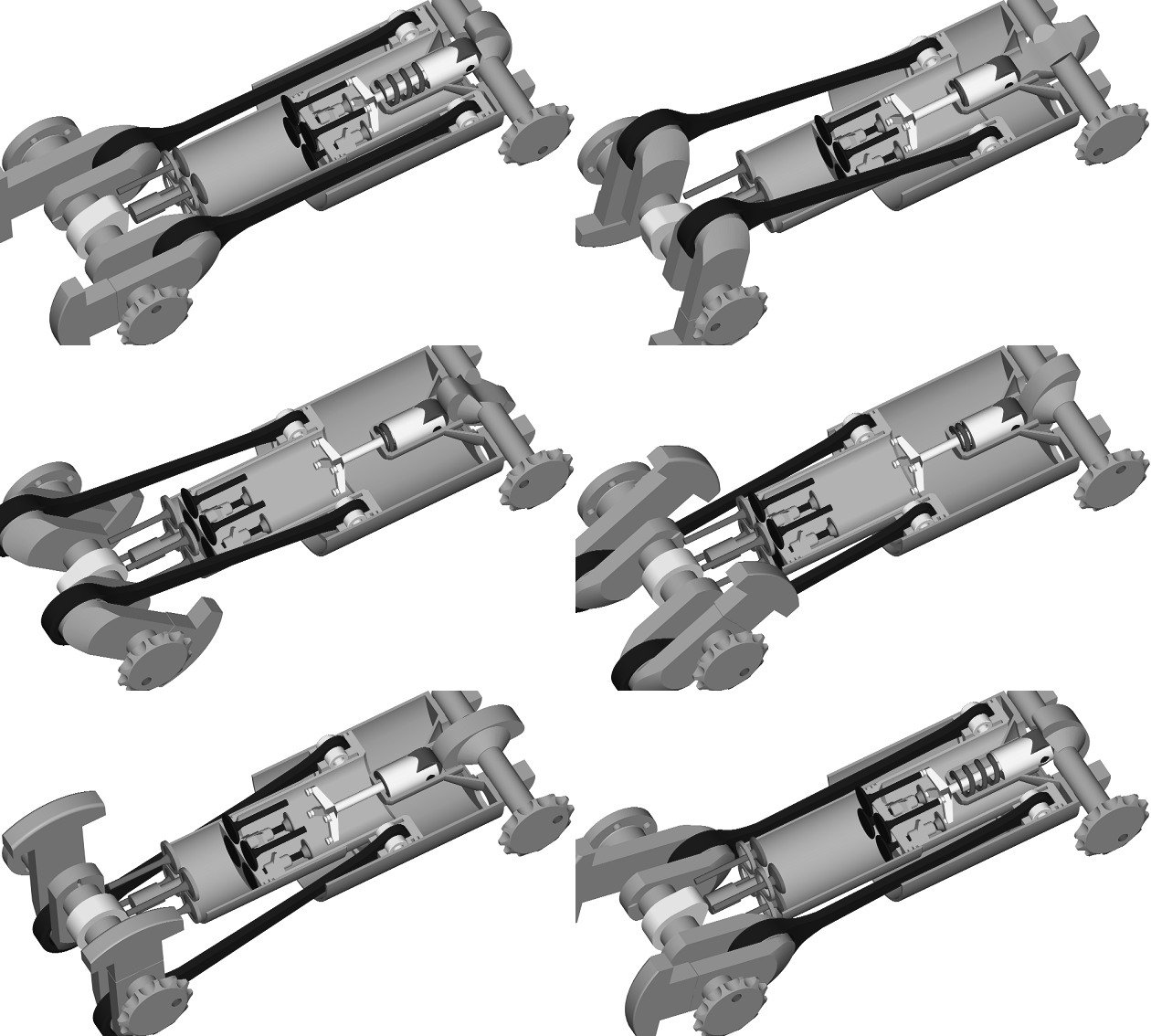
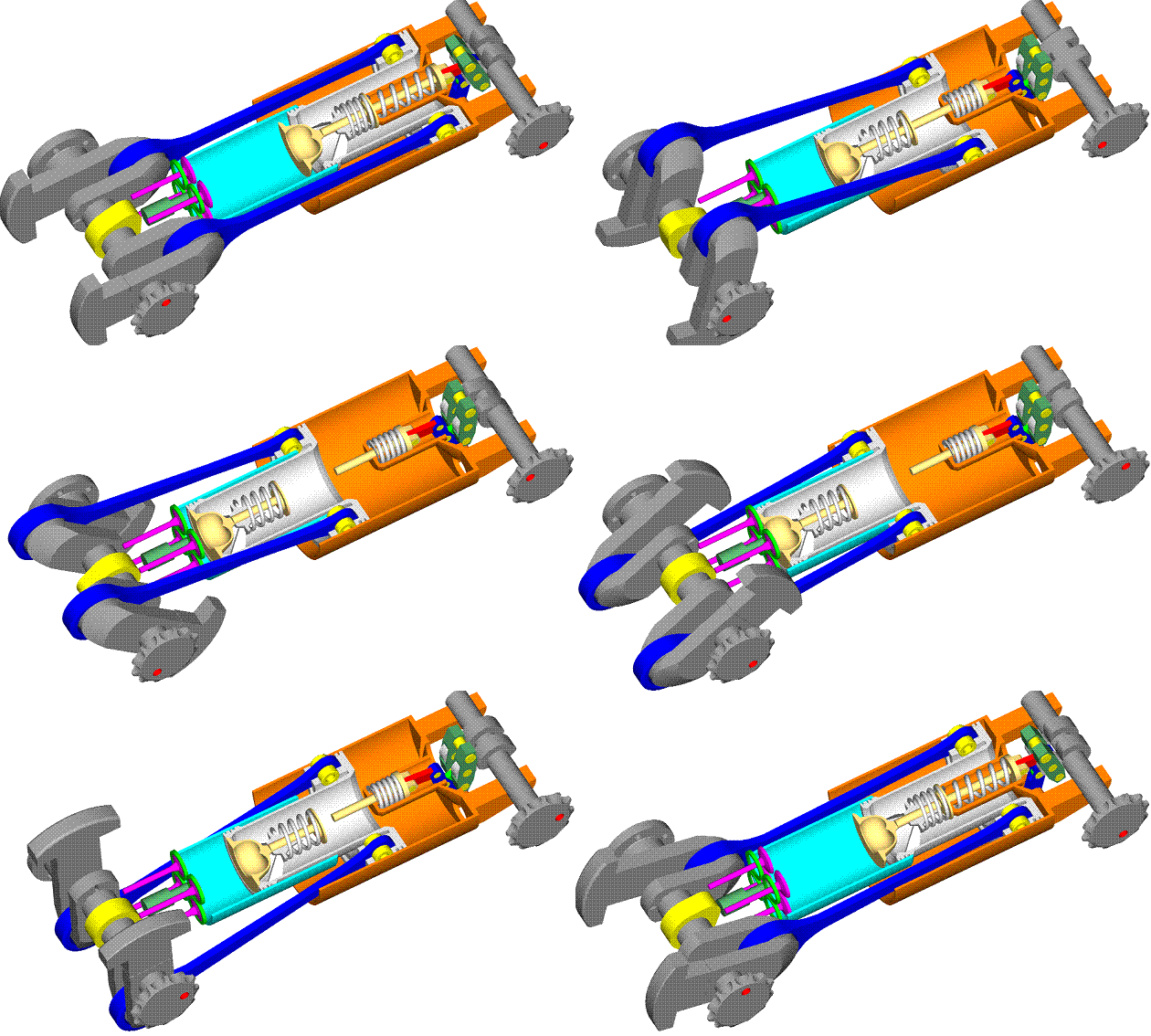
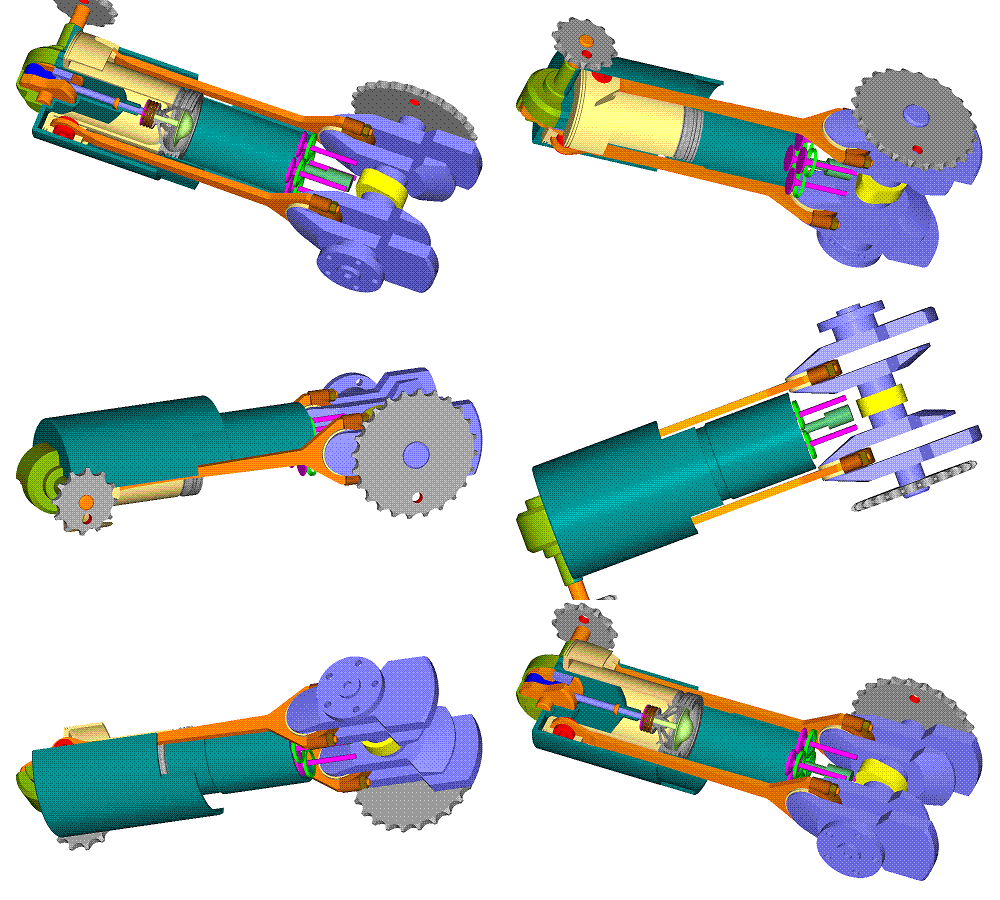
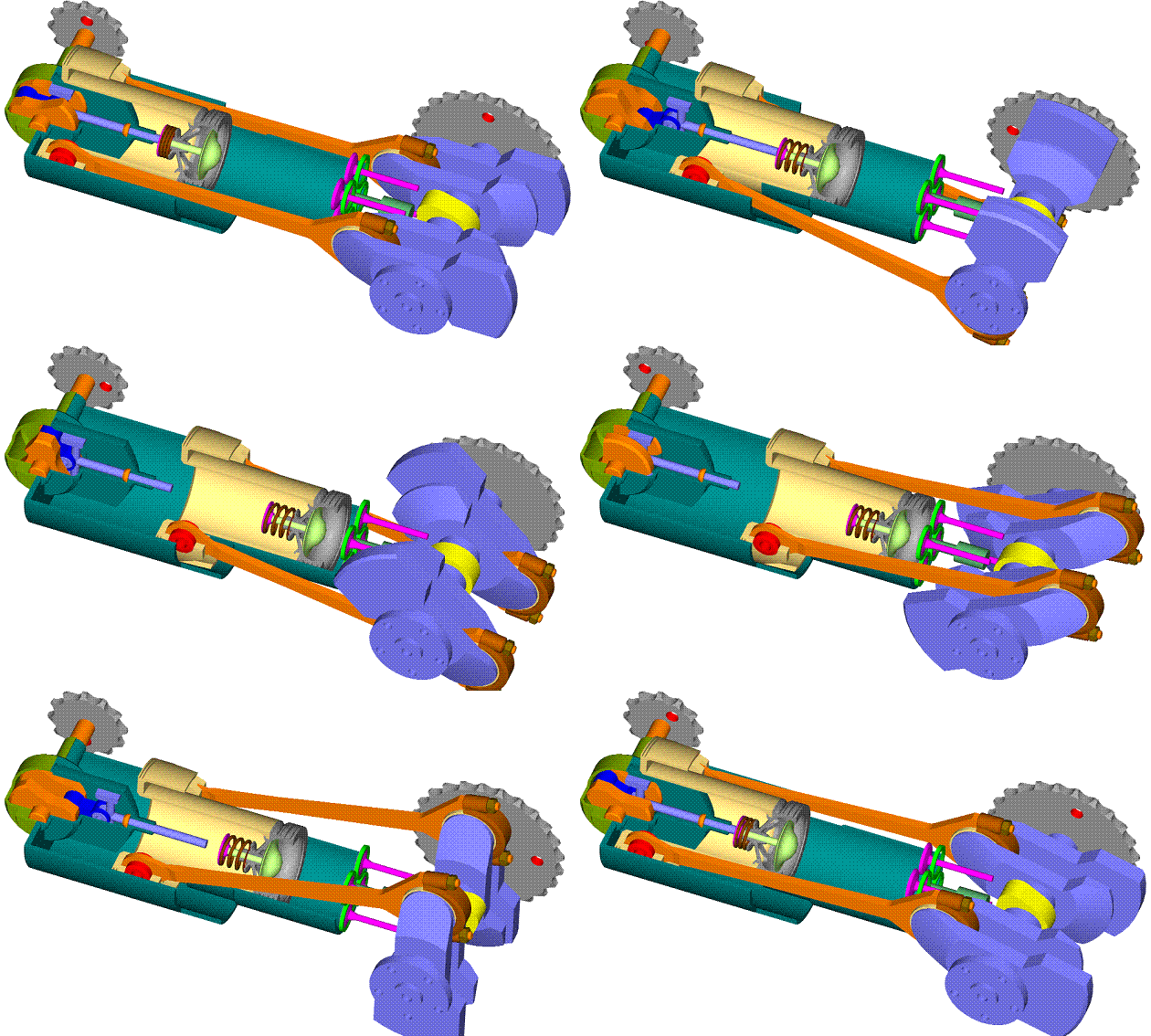
It is a port-less through-scavenged two-stroke engine.
Click here
to dowload a controllable windows exe animation,
or click here for a color / gif animation.
With the cylinder-liner rid of intake and exhaust ports, this engine combines:
true "four-stroke" lubrication,
true "four-stroke" specific lube consumption,
true "four-stroke" scuffing resistance,
uniflow scavenging efficiency,
double valve-area and
some 30% longer piston dwell at the CTDC (Combustion Top Dead Center).
Valve-time-area:
A similar four-stroke engine has nearly the same valve-time-area with the PatPortLess (the time halves, but the valve-area doubles) resulting in a similar energy per explosion at the same revs; for every power explosion of the four-stroke they happen two power explosions of the PatPortLess, giving nearly double power.
In comparison to the conventional port-less two-stroke engines (transfer and exhaust poppet-valves on the cylinder head, loop-scavenged) the valve-area of the PatPortLess is double, resulting in double valve-time-area at the same revs (i.e. double power density).
Lubrication:
The piston and the piston rings are lubricated by the crankcase lubricant as in the conventional four-stroke engines, while the working medium is isolated from the crankcase lubricant as the working medium of the conventional four-stroke is isolated from the crankcase lubricant.
In the PatPortless the air sees no more lubricant oil than what it sees in the conventional four stroke engine.
Longer piston dwell:
Unlike the conventional engines wherein the connecting rods are push-rods, the connecting rods of the PatPortLess are pull-rods: they are heavily loaded only in tension; the loads try to straighten / to unbend them (thinner and lightweight con-rods).
The PatPortLess arrangement shifts the combustion to the slow dead center.
In a conventional engine having a "connecting rod to stroke" ratio equal to 2, the crank angle during which the piston remains at the top 10% of its stroke is 66.2 degrees.
In a PatPortLess having a "connecting rod to stroke" ratio equal to 2, too, the crank angle during which the piston remains at the top 10% of its stroke is 83.9 degrees.
At the same revs (rpm), the piston of the PatPortLess remains in the top 10% of its stroke for 27% more time than the piston of the conventional (83.9/66.2=1.27).
Equivalently, when the PatPortLess operates at 27% higher revs than the conventional, the pistons of both remain in the top 10% of their strokes for the same time. For instance, when the abovementioned PatPortLess operates at 6000 rpm and the abovementioned conventional operates at only 4.750 rpm (=6000/1.27), the pistons of both remain in the top 10% of their strokes for (83.9/360)*(60/6000)=0.00233 seconds.
For lower "connecting rod to stroke" ratios, things get worse for the conventional.
For shorter intervals near the CTDC (say 5% of the piston stroke instead of the 10% used in the previous comparison), things get worse for the conventional.
In a reciprocating engine having 15:1 compression ratio:
when the piston has covered 5% of its stroke moving away from the Combustion TDC, the "remaining" expansion ratio has drop to 8.8:1; any quantity of fuel burned at that moment would undergo an expansion ratio of 8.8.
when the piston has covered 10% of its stroke moving away from the Combustion TDC, the "remaining" expansion ratio has drop to 6.25:1; any quantity of fuel burned at that moment would undergo an expansion ratio of only 6.25.
The additional time provided for the preparation / combustion of the fuel enables a better control over the engine, improves the brake thermal efficiency of the engine, reduces the exhaust emissions, increases the power density, etc. For more, click on OPRE or on
OPRE2
Operation:
The piston comprises valve seats and valve guides.
The piston bears transfer poppet valves and restoring springs.
The exhaust valves of the cylinder head are controlled conventionally, for instance by cams secured to the crankshaft.
A transfer camshaft rotates in synchronization with the crankshaft (by sprockets, gears etc).
A valve actuator is displaced by the transfer camshaft and is restored by restoring springs.
During the compression, the combustion and the expansion, the transfer valves move together with the piston, seated on their valve seats on the piston crown.
The right moment the exhaust valves open and the pressure inside the cylinder drops.
At a crankshaft angle the transfer valves land on the valve actuator and start following its motion.
Compressed air from the backside of the piston enters, through the valve-seats / ports on the piston crown, into the cylinder and scavenges the exhaust gas.
The right moment the exhaust valves close.
Compressed air continuous to enter the cylinder until the transfer valves land on their valve seats on the piston crown and start following the piston motion.
The compression begins.
The combustion chamber pressure improves the sealing of the transfer valves.
Click on the plot to enlarge.
The plot shows the piston motion vs the crankshaft angle (red curve).
It also shows the absolute transfer valve motion (cyan curve). For many degrees the transfer valve moves together with the piston, as a body, and the cyan curve stays "inside" the red curve.
The plot also shows the transfer valve lift (blue curve, continuous line). It is the motion of the transfer valve relative to the piston motion. Differently: it is the distance of the piston position (red curve) from the transfer valve position (cyan curve).
It also shows the exhaust valve lift (beige curve, continuous line).
The dash-line curves are the transfer valve lift (blue) and the exhaust valve lift (beige) magnified by ten times.
Transfer camlobe profile:
A good transfer camlobe profile has to allow the transfer valves to pass smoothly, quietly and reliably from the motion with the piston to the motion with the valve actuator (and vice versa), it also has to protect the transfer valves, and their restoring springs, from excessive valve lifts.
Combustion bowl formed into the "head" of the single transfer valve:
Click on the above gif animations to dowload the full-size controllable windows exe animation.
PatPortLess with "Crank-Cam" transfer valve actuation:
Click on the above gif animations to dowload the full-size controllable windows exe animation.
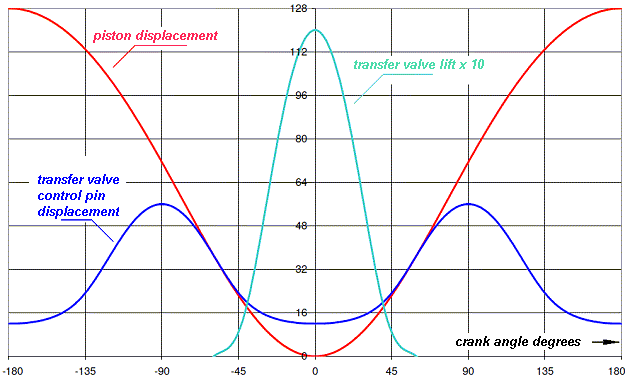
The above plot shows the piston displacement, the displacement of the transfer valve actuation pin, and the (magnified by ten times) transfer valve lift.
The transfer valve lift is the difference between the displacement of the transfer valve actuation pin and the displacement of the piston.
Click on the above gif animations to dowload the full-size controllable windows exe animation.
The transfer valve is the bottom of the combustion bowl. The small crank (orange) rotates at double speed (relative to the main crankshaft speed) and causes the reciprocation of the transfer valve control pin.
Balancing the single cylinder PatPortLess:
In the GIF animation below, the balance webs on the crankshaft (cyan), the (red) contra-rotating counterweight besides the crankshaft (at right), and the (red) contra-rotating small counterweights secured on the transfer camshaft (at left) balance completely the first order inertia force without increasing the inertia torque.
The vibration-free quality of this single cylinder PatPortLess is better than the vibration-free quality of the four-stroke two-cylinder TwinAir engine of FIAT used in several successful small and medium size cars: the two engines have the same number of combustions per crankshaft rotation, but the PatPortLess has a better balancing (the single counter-rotating balancing shaft of the FIAT TwinAir engine cancels the first order inertia force in expense of a substantially increased inertia torque; this is why in engines like the Yamaha TDM it is used a pair of counter-rotating balancing shafts).
A single cylinder for the propulsion of small / medium size cars, sounds bizarre.
Today most people would not even consider buying a medium size car having a single cylinder engine.
However if the two-cylinder four-stroke TwinAir of FIAT is good for the Alfa Romeo Mito, and if the VW TSI ACT (cylinder deactivation) is good for the VW POLO when it operates with only two cylinders, the single cylinder PatPortLess is better.
In the GIF animation below, the transfer valve actuation mechanism comprises a "rocker-arm" (blue) having a pair of roller-bearing cam-followers (green).
The holes at the top of the big cylinder (at left) can either be just holes through which compressed air is fed to the engine (from a turbocharger, for instance), or they can comprise reed valves to form a zero-cost built-in supercharger, or some of them can comprise reed valves with the rest being controlled by a throttle valve for a twin-charger PatPortLess.
Instead of sprockets, a pair of gearwheels can be used for the driving / synchronization of the red counter-weight at right.
Simple, lightweight and compact structure.
Click on the above image
Built-in charger:
The backside of the piston can, optionally, be used as a no-cost volumetric scavenging pump / charger. All it takes is a reed valve (or a rotary/sleeve valve on the camshaft, or a disk valve) to trap the air suctioned untill the transfer valves open.
The driving of this built-in "charger" involves no friction.
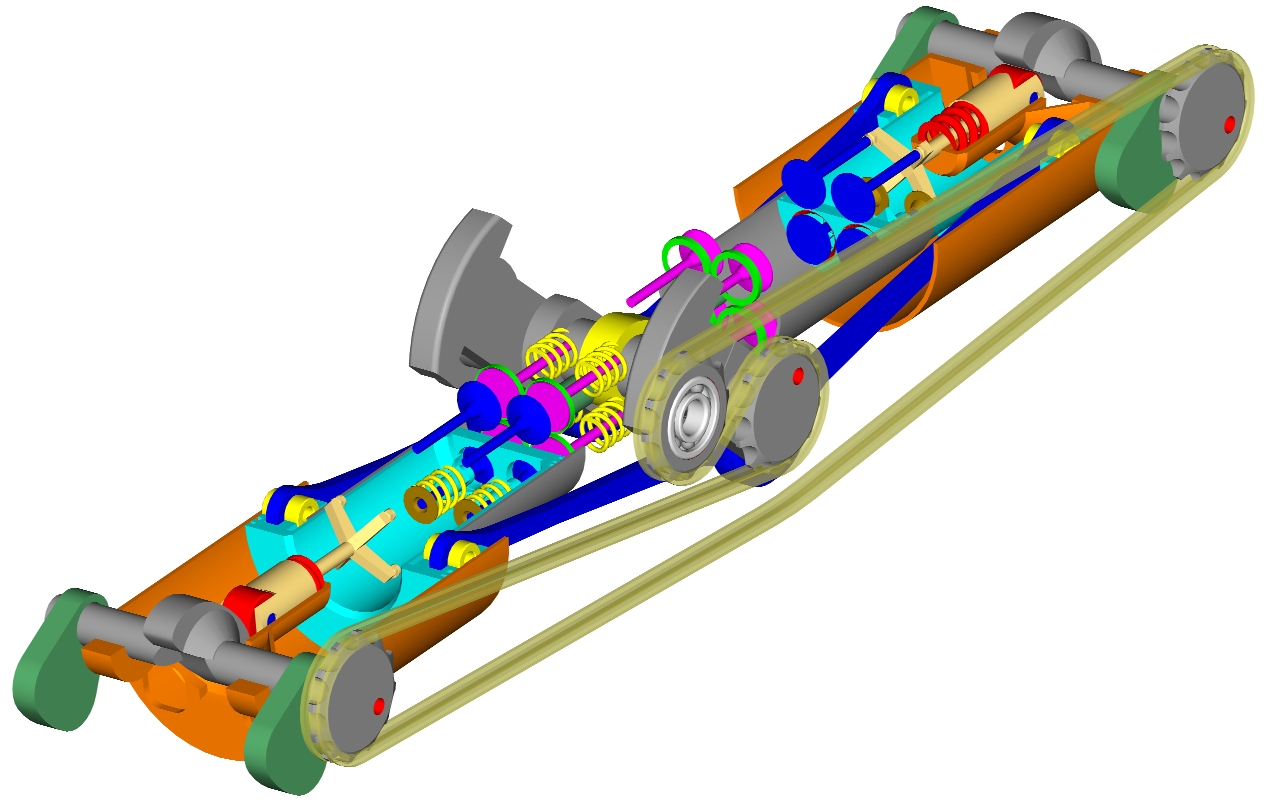
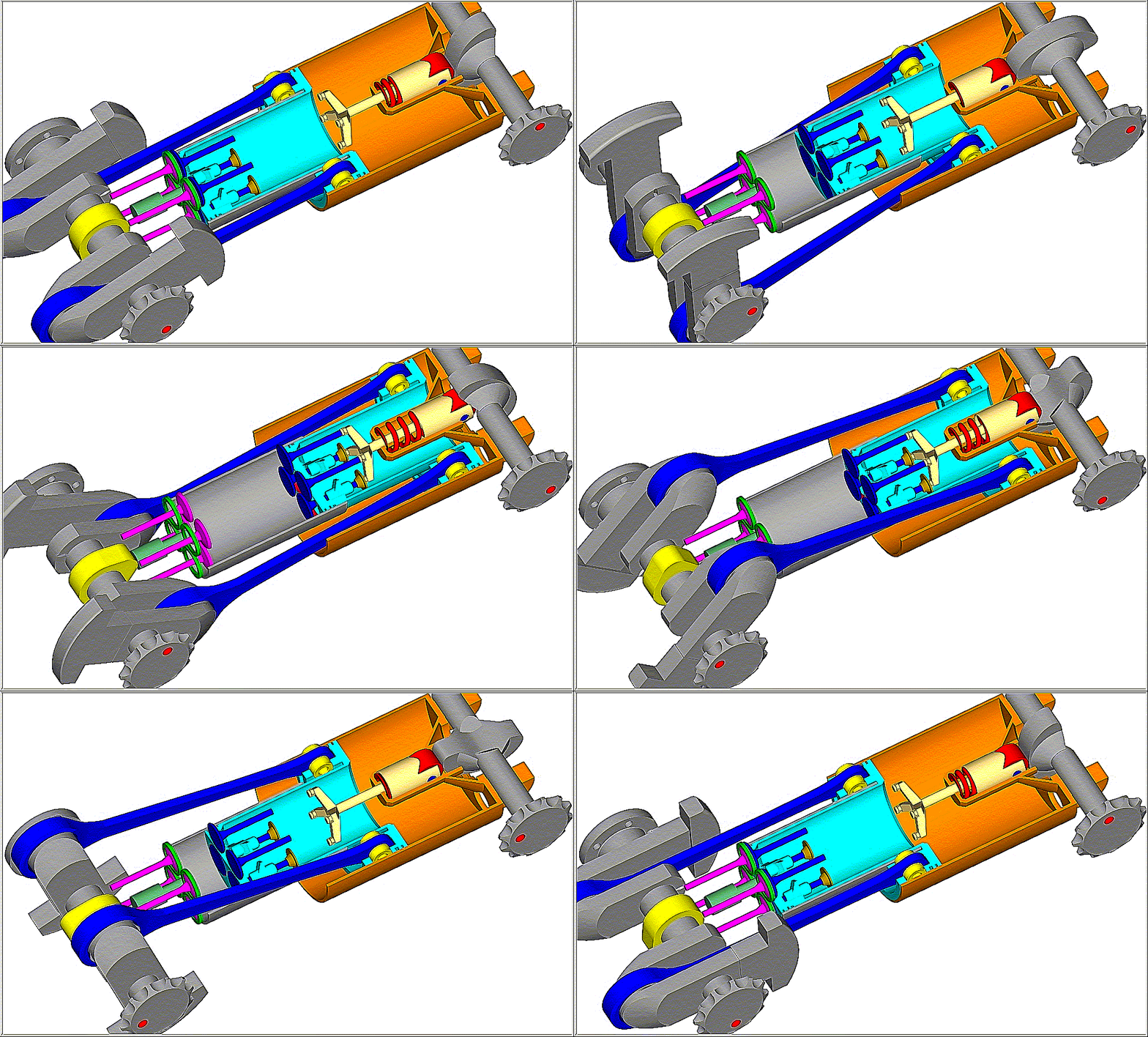
By counterweights secured on the two transfer camshafts, the above even firing opposed-cylinder is full balanced (as much, as the OPOC engine).
The valve timing is as asymmetrical as necessary.
The connecting rods are pulling-rods.
The total length of this flat twin is less than seven times the piston stroke.