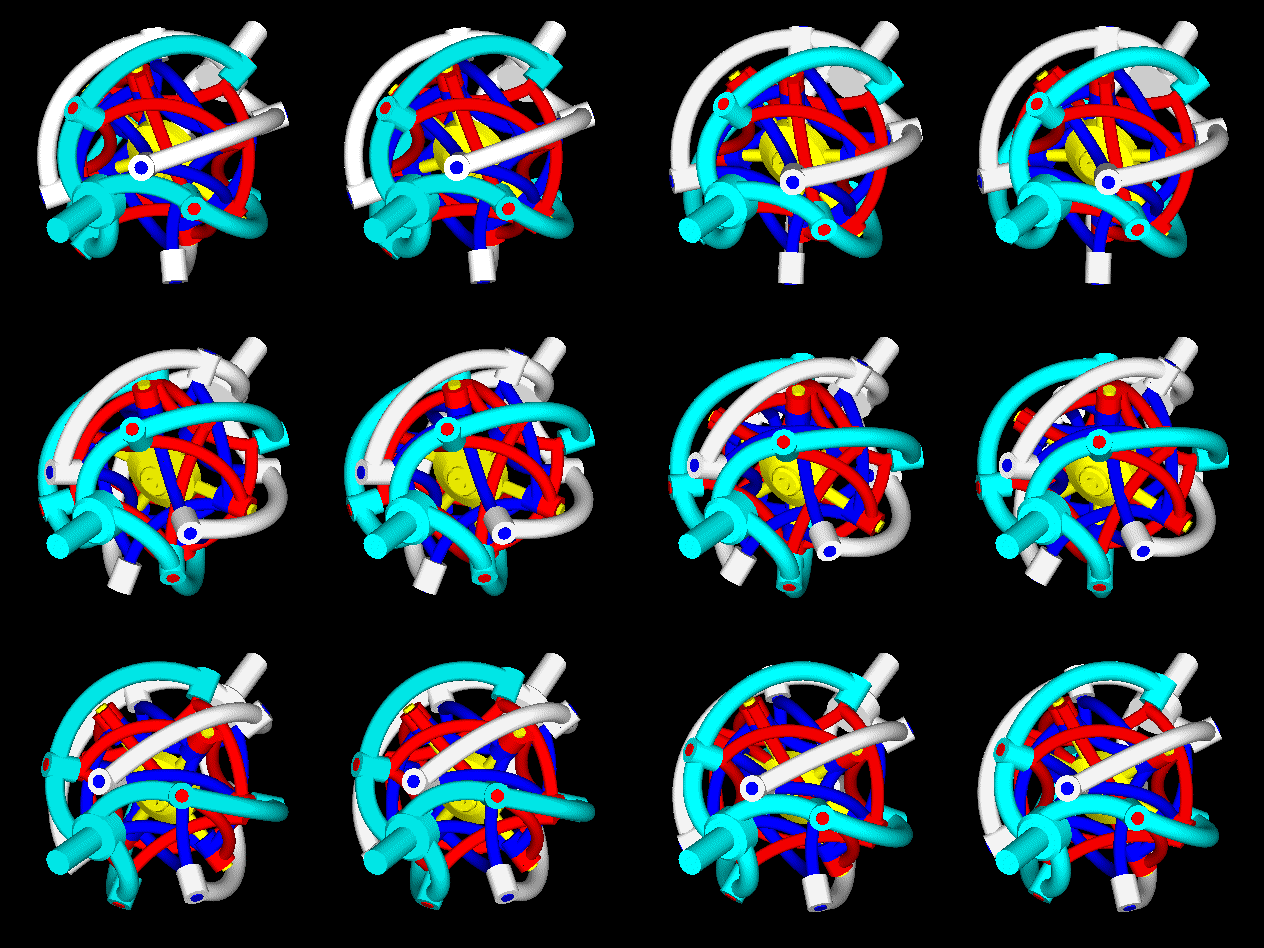
According the inventor and maker of the TCVJ coupling, a minimum angle of two degrees
between the shafts is required, otherwise the parts of the TCVJ coupling rapidly wear.
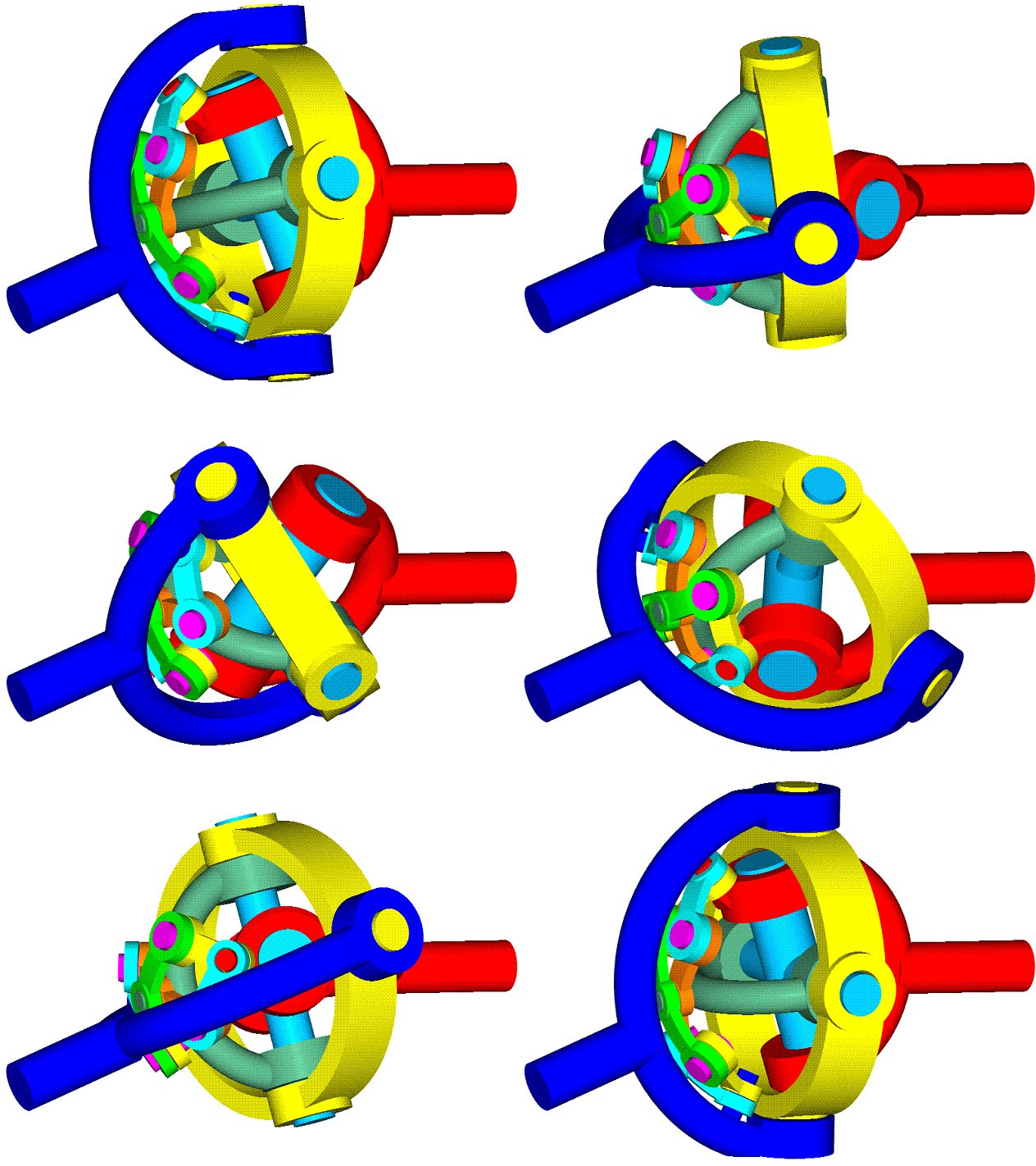
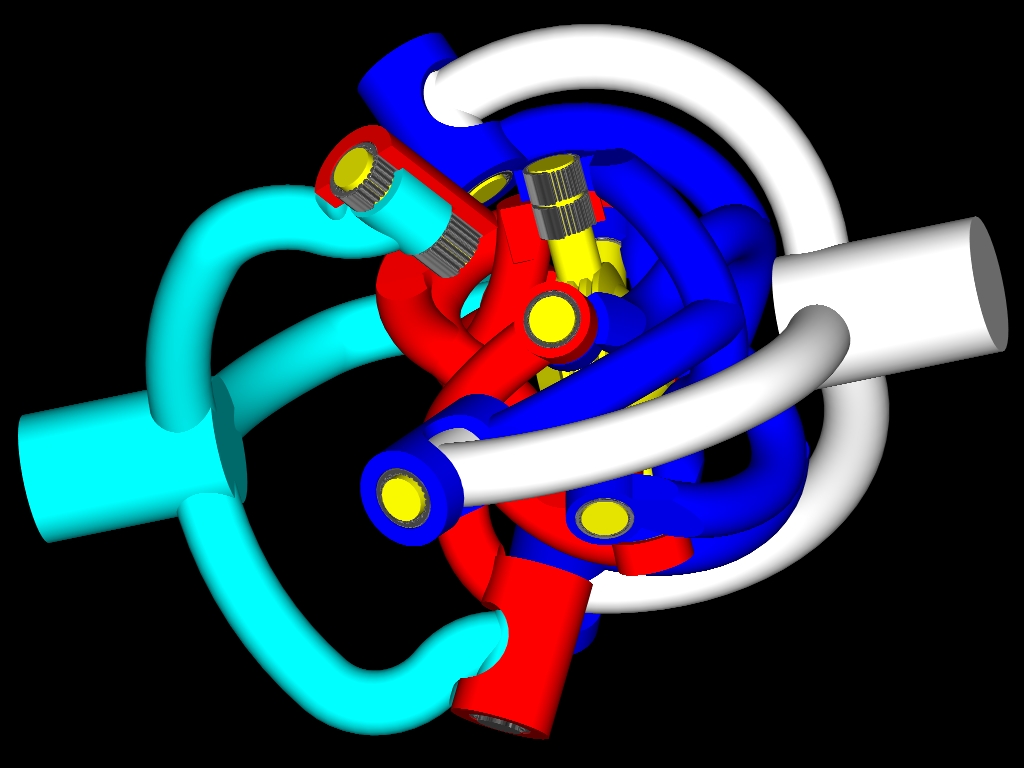
The PatCVJ eliminates the weakness of the state-of-the-art TCVJ constant-velocity-joint (Thompson coupling) to operate reliably with the two shafts at, or near, a straight line.
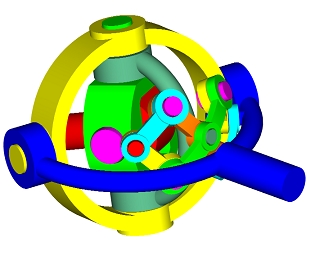
Click on the above gif animation to dowload the controllable windows exe animation (7MB).
Both, the PatCVJ and the TCVJ comprise a main set of yokes and an auxiliary set of yokes / links.
The "main set of yokes" comprises:
a first yoke (the cyan cross at the center, in the animation above) pivotally mounted to a first shaft (the red shaft),
a second yoke (the yellow ring-cross) pivotally mounted to a second shaft (the blue shaft),
and a "control" yoke (the dark green fork) which is pivotally mounted to said first yoke and to said second yoke so that the three yokes of the "main set of yokes" pivot about a common axis.
The three "main yokes" make the hard work of transferring the torque load and the axial load from the one shaft to the other.
The "auxiliary set of yokes" comprises six articulated arc-shaped links (or yokes) that constitute a spherical pantograph mechanism (the two yellow links, the two cyan links, the green "rocker" link and the brown "rocker" link in the above animation). The one end of the pantograph pivots about an oblique pin of the first shaft, the other end of the pantograph pivots about an oblique pin of the second shaft. The center of the spherical pantograph keeps the "control" yoke at the right orientation so that the transmission ratio remains strictly at 1:1.
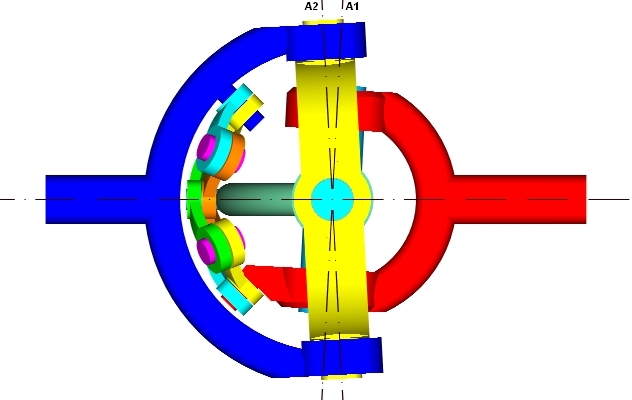
What distinguishes the PatCVJ from the TCVJ is that the pivot axis A1 between the first yoke and the first shaft of the PatCVJ is oblique to the rotation axis of the first shaft, and that the pivot axis A2 between the second yoke and the second shaft of the PatCVJ is oblique to the rotation axis of the second shaft.
Depending on how much oblique are the abovementioned pivot axes:
either the two pivot axes A1 and A2 avoid completely getting coaxial, as in the arrangement of the above animation,
or the mechanism avoids the condition wherein both occur simultanuously: the spherical pantograph "bends" from side to side with the bearing-pins knocking from side to side of their bearings, and, the bearing-pins do not rotate "sufficiently" into their bearings.
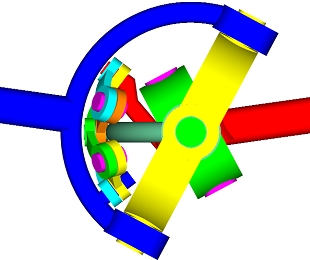
In the PatCVJ version shown below, the pivot axes A1 and A2 (shown by dashed-dot line) of the first and of the second yokes are only a few degrees away from being normal to their respective shafts (3 degrees here).
The slight oblique keeps the thrust loads on the bearings small.
In order to provide the necessary support to the "control" yoke, the spherical pantograph mechanism needs to "bend" slightly.
For a given direction of the incoming torque, the load on the spherical pantograph mechanism of the TCVJ coupling changes direction during each shaft rotation.
The spherical pantograph bends slightly at one direction to provide the necessary support (force) to the "control" yoke.
Then, at the rotation angle wherein the pivot axes of the first and second main yokes get coaxial, the spherical pantograph unbends and passes from its "straight" / unloaded condition wherein no support to the "control" yoke is provided.
Then the spherical pantograph bends at the opposite direction to provide the necessary support to the "control" yoke.
I.e. during each shaft rotation the pantograph of the TCVJ bends, then straightens, then bends at the opposite direction and then straightens again.
In comparison:
Case of adequately oblique pivot axes:
For a given direction of the incoming torque, the load on the spherical pantograph mechanism of the PatCVJ coupling is permanently at the same direction; the spherical pantograph remains permanently "bent" at the same direction, and remains permanently loaded, even when the PatCVJ operates with the shafts at a straight line.
This is so, because the pivot axes A1 and A2 of the PatCVJ coupling never get coaxial.
This way, in the PatCVJ there are not "forbidden angles" between the shafts, like the -2 degrees to +2 degrees angle interval wherein the TCVJ wears rapidly. On the contrary, the operation with the shafts at, or near, a straight line is the most efficient and reliable for the PatCVJ.
Case of "nearly" perpendicular pivot to rotation axes:
If f is the angle between the pivot axes A1 and A2 when the two shafts are at a straight line, then, with the shafts at any angle from zero to f, a constant direction incoming torque loads the spherical pantograph mechanism permanently at the same direction throughout the entire shaft rotation (i.e. the spherical pantograph avoids to "bend at one direction, then to straighten, then to bend at the opposite direction and then to straighten again" once per shaft rotation).
With the shafts being at, or near, a straight line, the bearings of the spherical pantograph mechanisms of both couplings (TCVJ and PatCVJ) either do not rotate at all (case of shafts at a straight line) or they perform a slight angular oscillation.
But in the PatCVJ, the pin of any bearing of the spherical pantograph mechanism abuts constantly on the same side of the bearing eliminating the wear.
In comparison, the pins of the spherical pantograph mechanism of the TCVJ go from side to side, knocking on the surface of their bearings, cleaning the bearing surface from the lubricant and causing wear. Besides the reliability issues, the bending - unbending of the spherical pantograph mechanism (in order to provide the necessary support to the TCVJ control yoke) causes a slight variation of the transmission ratio around the correct 1:1.
For angles bigger than f, the spherical pantograph bearings of the PatCVJ rotate "sufficiently" and lubricate normally, avoiding the wear (just like the TCVJ avoids the wear when it operates at shaft angles bigger than a minimum).
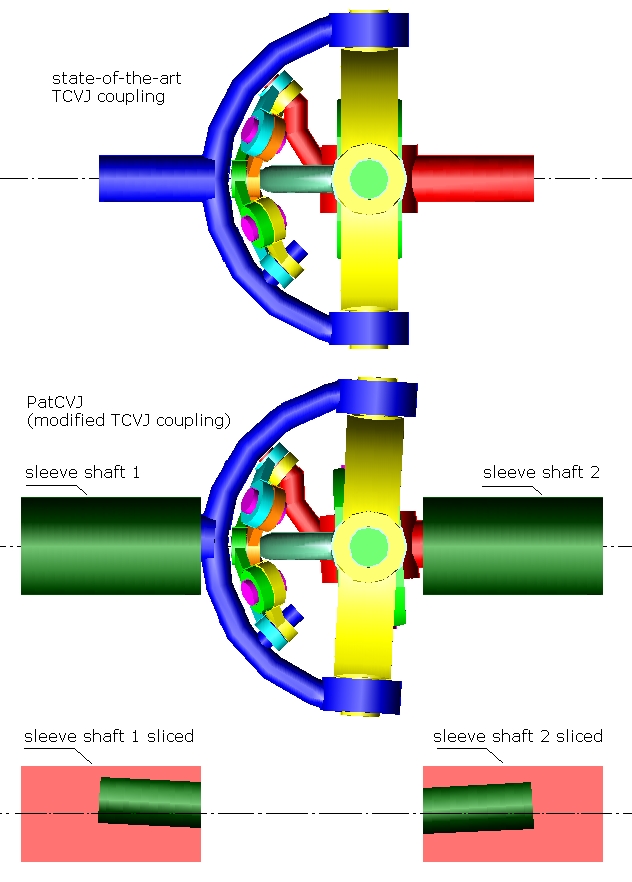
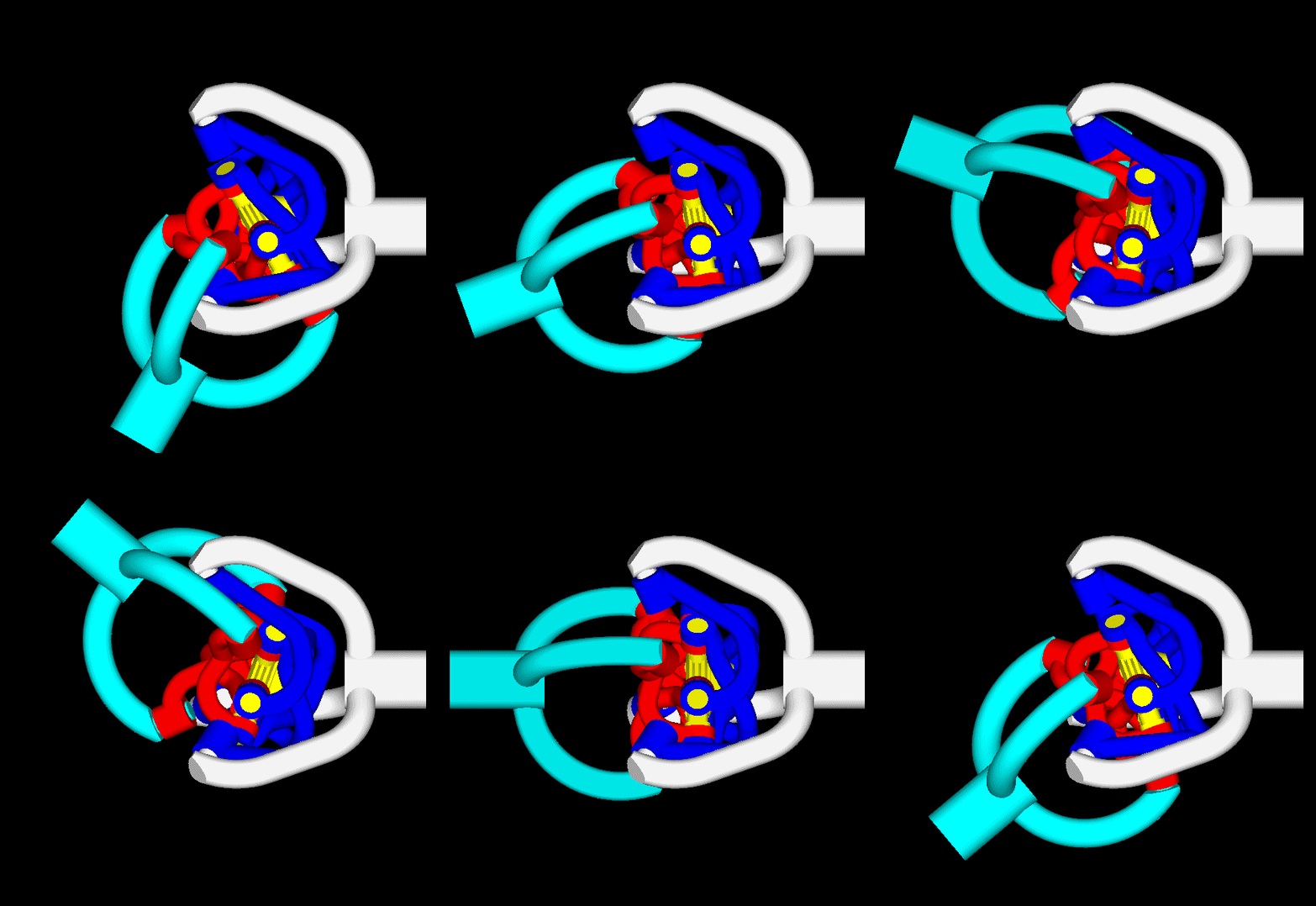
In the drawing below they are shown:
at top, the TCVJ coupling with its shafts at a straight line (i.e. wherein it cannot operate without wearing its bearings);
in the middle the same TCVJ coupling modified to PatCVJ; all it takes is two "sleeve shafts" fixed onto the original shafts of the TCVJ;
at the bottom they are shown the two "sleeve shafts" sliced.
The angle between the rotation axis of the "sleeve shaft" and the hole of the "sleeve shaft" wherein the original shaft of the TCVJ is fixed, is 3 degrees here.
Geometrically the TCVJ coupling is perfect, but the inevitable flexibility of the parts and the inevitable lash of the bearing-connections spoil the geometry.
With the shafts of the coupling at one degree angle, the spherical pantograph performs an oscillating motion bending, like a chord, initially at one direction until it is adequately bend away to provide the necessary support (force) to the control yoke, then it bends at the opposite direction until it is adequately bend away to provide the necessary support to the control yoke at the other direction, and so on.
The impact loads of this motion combined with the "standstill" of the bearings (resulting from the small angle between the shafts) cause the fatigue of the bearings.
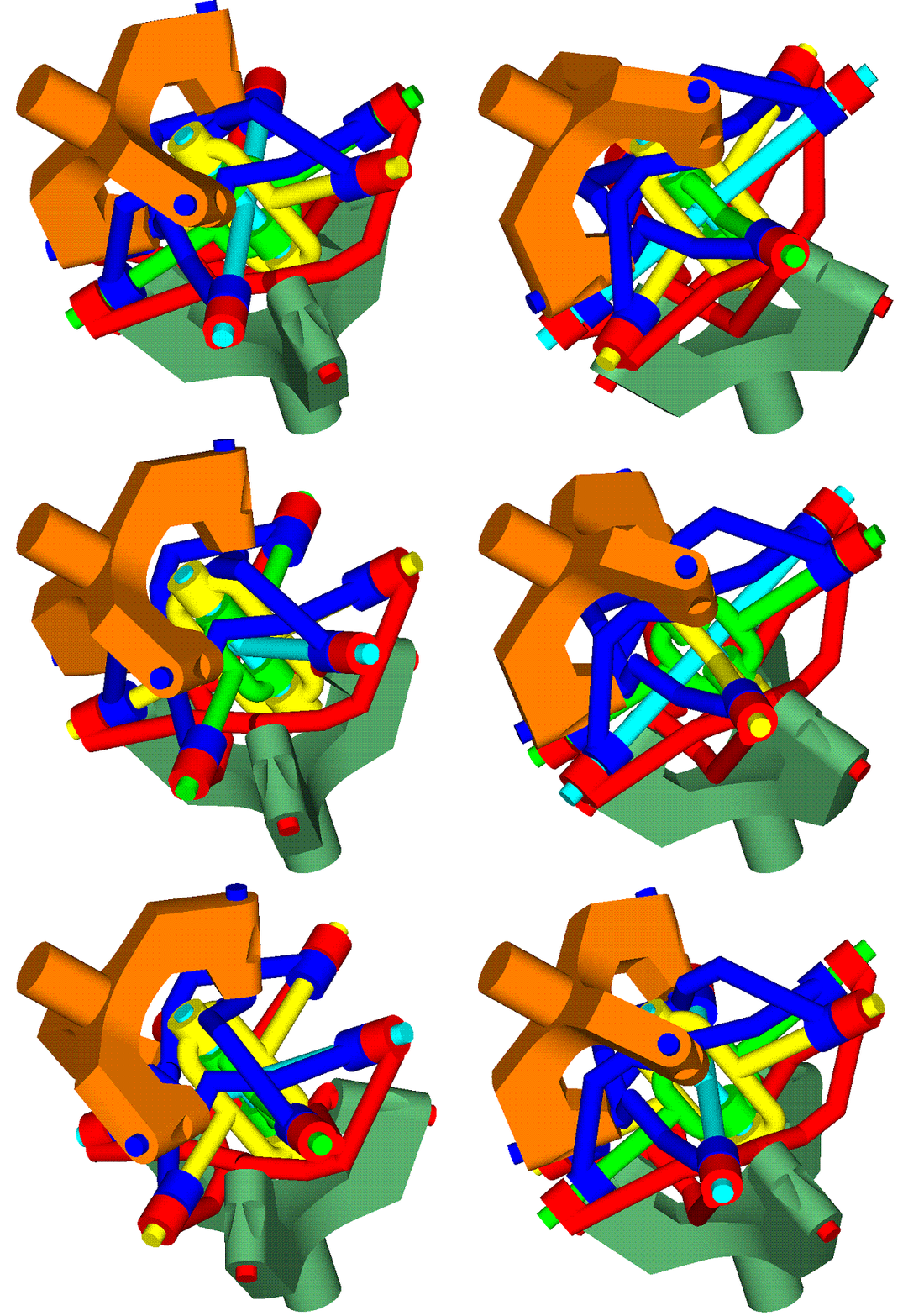
The PatDan Constant Velocity Joint is different.
It comprises three "main sets of yokes" like the abovementioned, and none "auxiliary set of yokes".
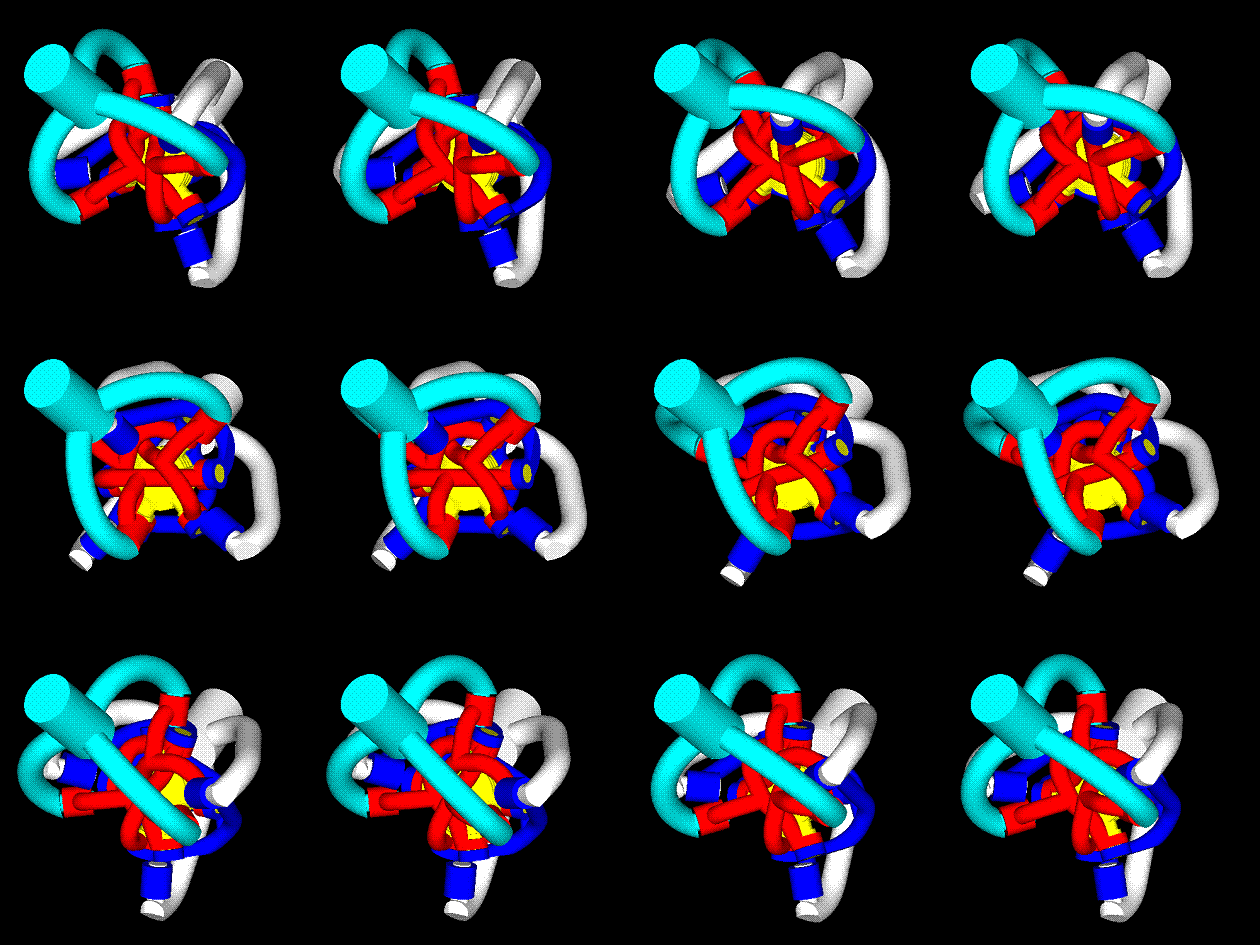
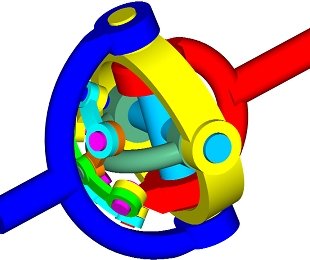
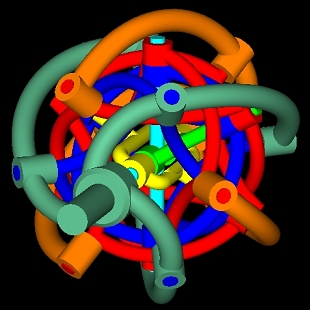
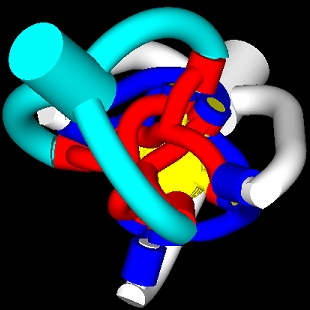
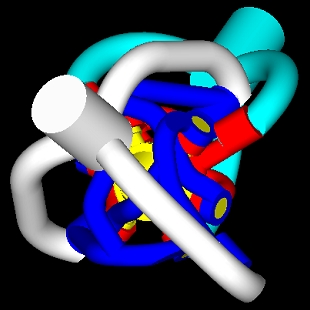
The three "control" yokes (the green, the yellow and the cyan crosses at the center of the animation below) are pivotally mounted to each other so that they pivot about a common axis.
The rest yokes are forks (the blue ones are pivotally mounted to the upper / brown shaft, the red ones are pivotally mounted to the lower / dark green shaft).
The forks are properly bend to allow wider angles of operation. The mechanism is shown here operating with 40 degrees angle between the two shafts, but it can go beyond 50.
The torque load and the axial load split among all yokes.
The PatDan can take heavy axial loads.
Click on the above gif animation to dowload the controllable windows exe animation (9MB).
The inertia "torsional" vibrations reduce.
Instead of having a single heavy "control" yoke that, with the shafts rotating at constant angular velocity, rotates at variable angular velocity generating an inertia torque and torsional vibrations,
the PatDan has three lightweight "control" yokes arranged at 120 degrees from each other.
The smoothness (absence of significant torsional vibrations) of the PatDan is better than the smoothness of the TCVJ and PatCVJ, just like the inertia torque of an even firing six cylinder engine is lower than the inertia torque of an even firing four cylinder engine.
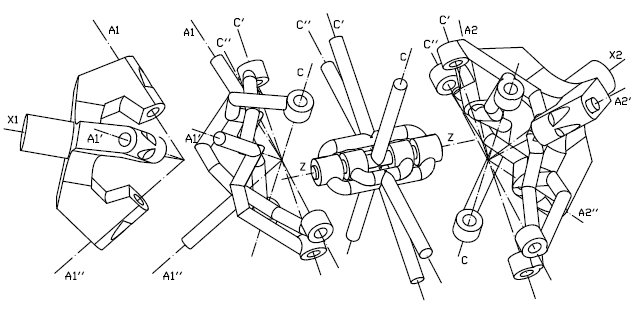
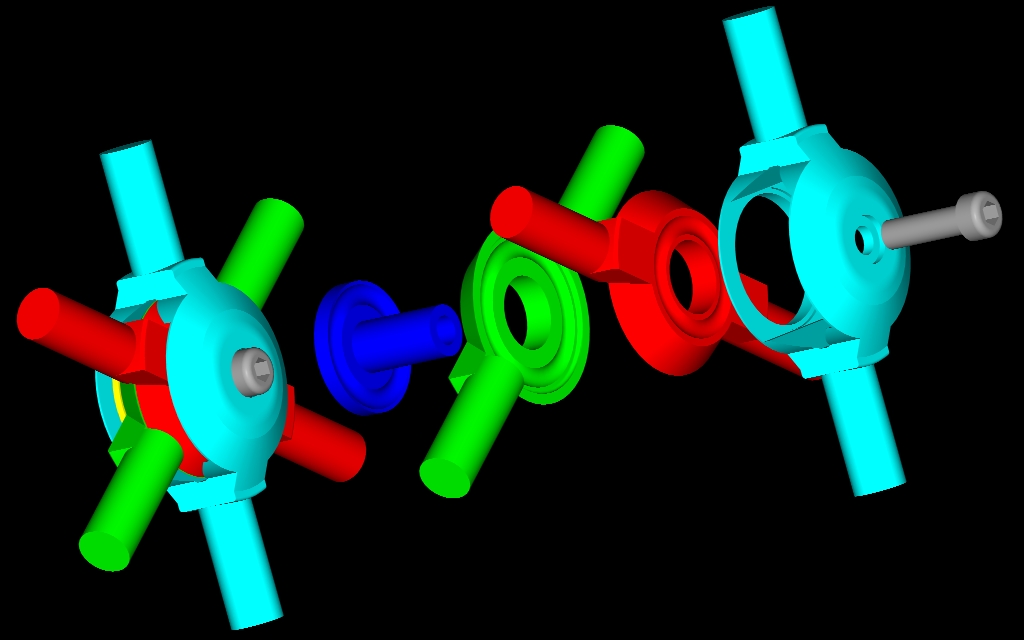
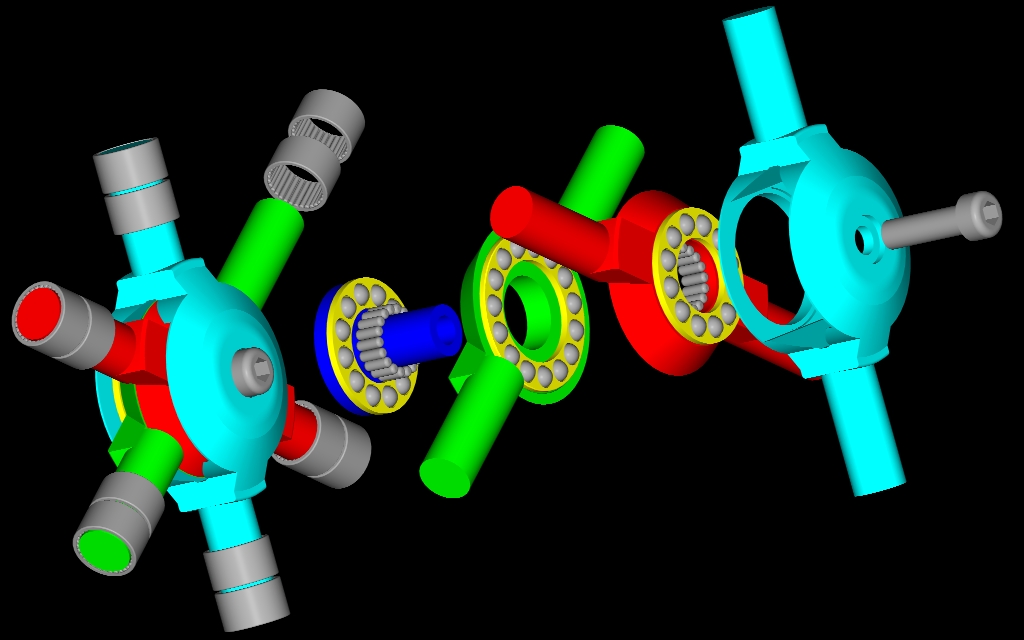
Below it is shown the PatDan coupling partly disassembled, also the pivot and rotation axes:
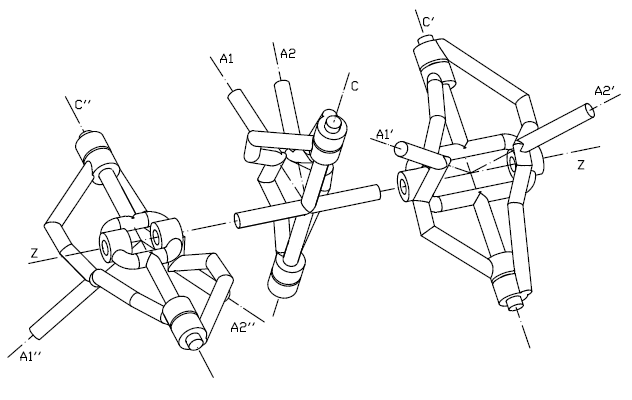
Below they are shown the three "main sets of yokes" and the respective pivot axes:
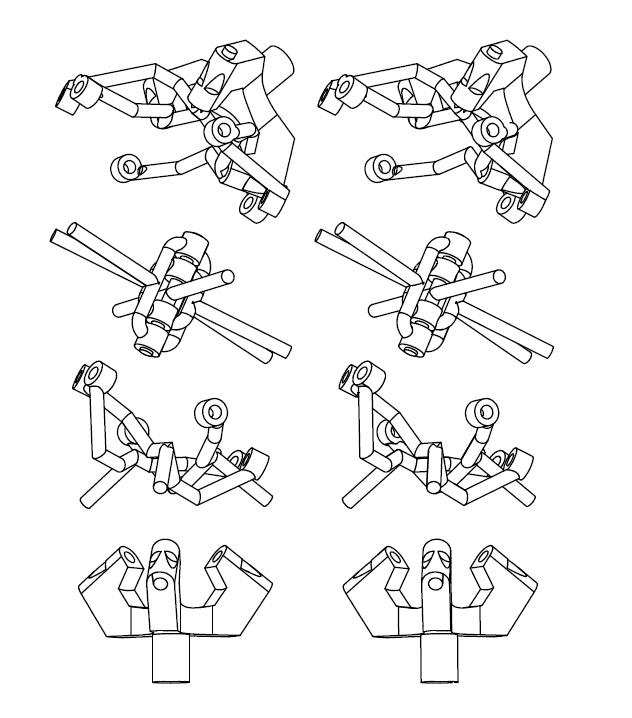
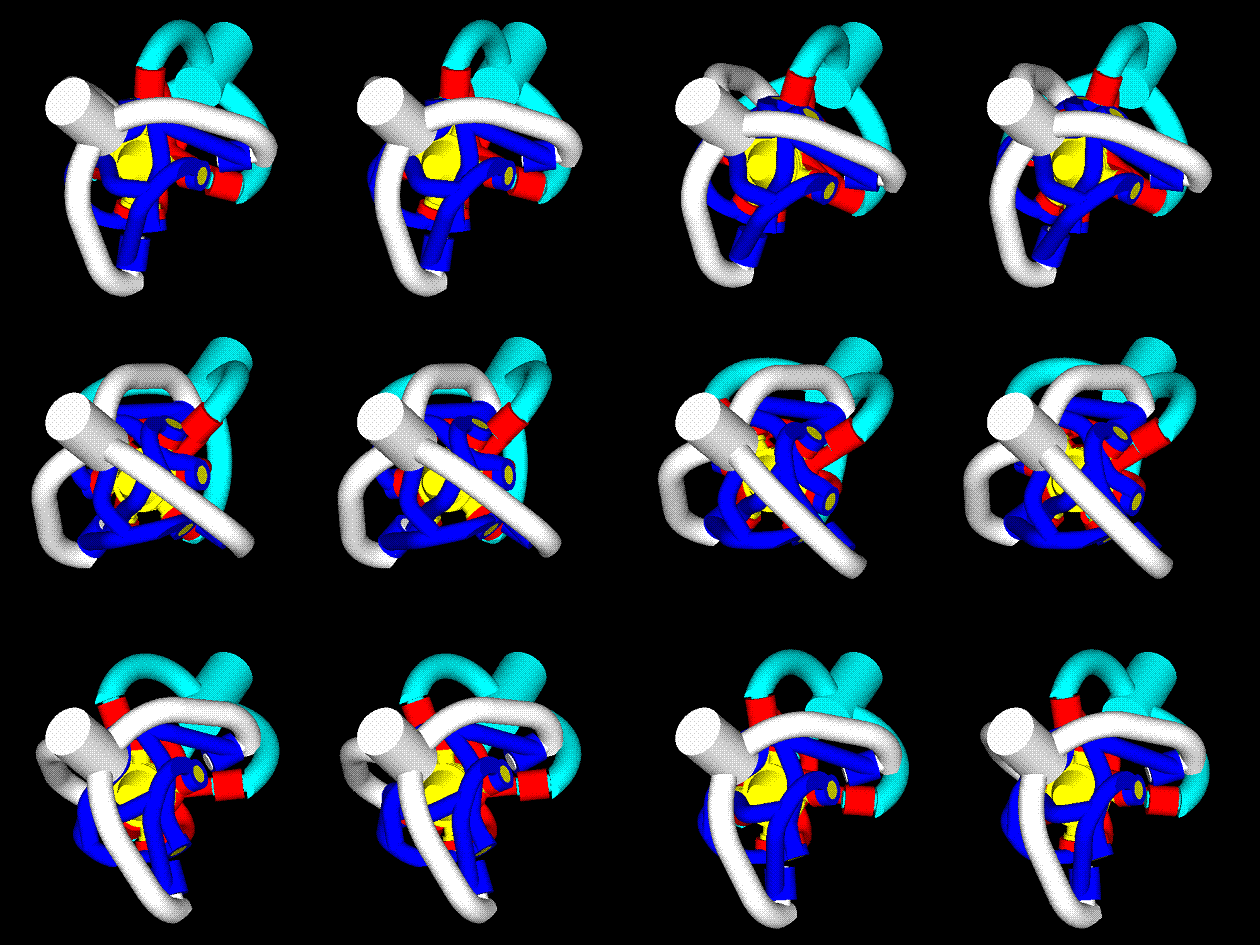
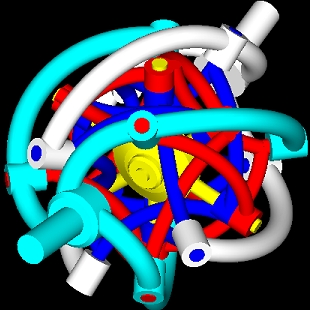
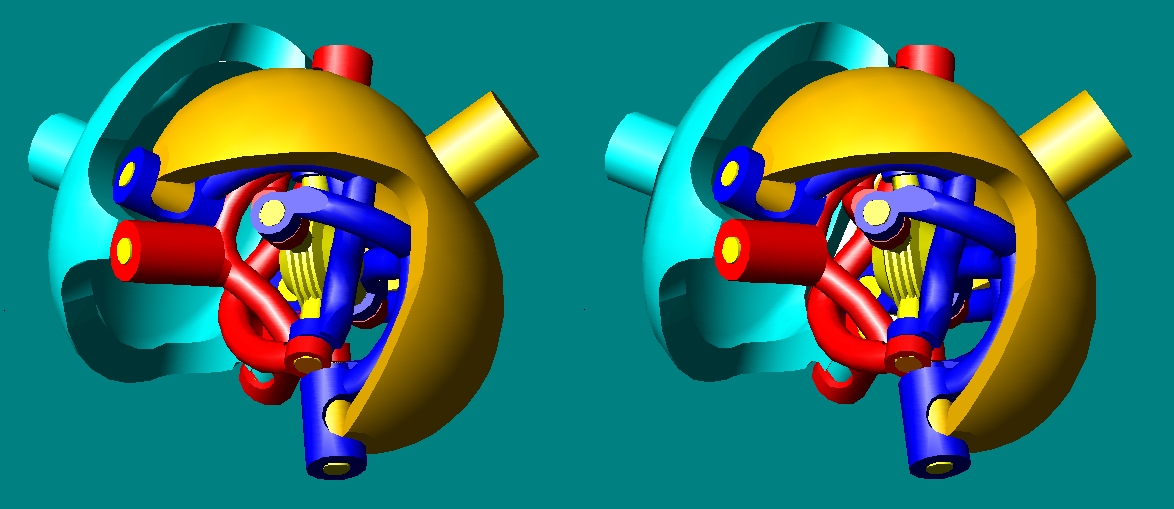
Below they are shown, stereoscopically, the parts of the PatDan:
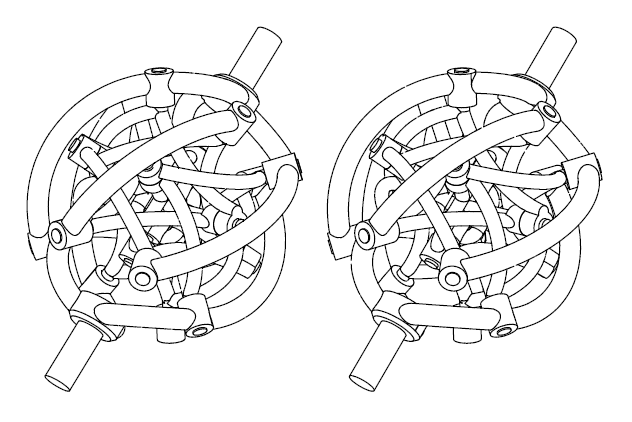
Below it is shown, stereoscopically, another PatDan version wherein crosses (supported at both ends) substitute the forks of the previous PatDan. The loads on the bearings are reduced.
Below it is shown the above PatDan operating at an angle of 20 degrees between its shafts.
The angle between the shafts is 60 degrees in the animations (and can be bigger).
In comparison the world's highest maximum operating angle of the Rzeppa CV joints of the automobile drive shafts is only 54 degrees (while the conventional design of the Rzeppa CV joint limits the maximum operating angle to less than 50 degrees).
The PatDan CV joint is based on roller bearings and is rid of loaded sliding surfaces.
In comparison the Rzeppa CV joint is based on heavily-loaded sliding surfaces wherein balls slide.
For the same wide angle between the shafts, the PatDan is by far more efficient than the Rzeppa CV joint (the first runs cold while the second soon overheats).
The PatDan has the qualifications to substitute the Rzeppa CV joints in the automobile drive shafts: true constant velocity joint, way more efficient, greater-steering-angles / smaller-turning-radiuses.
By the way, the PatDan can take heavy axial loads (mandatory in other applications) while the Rzeppa CV is not for axial loads.
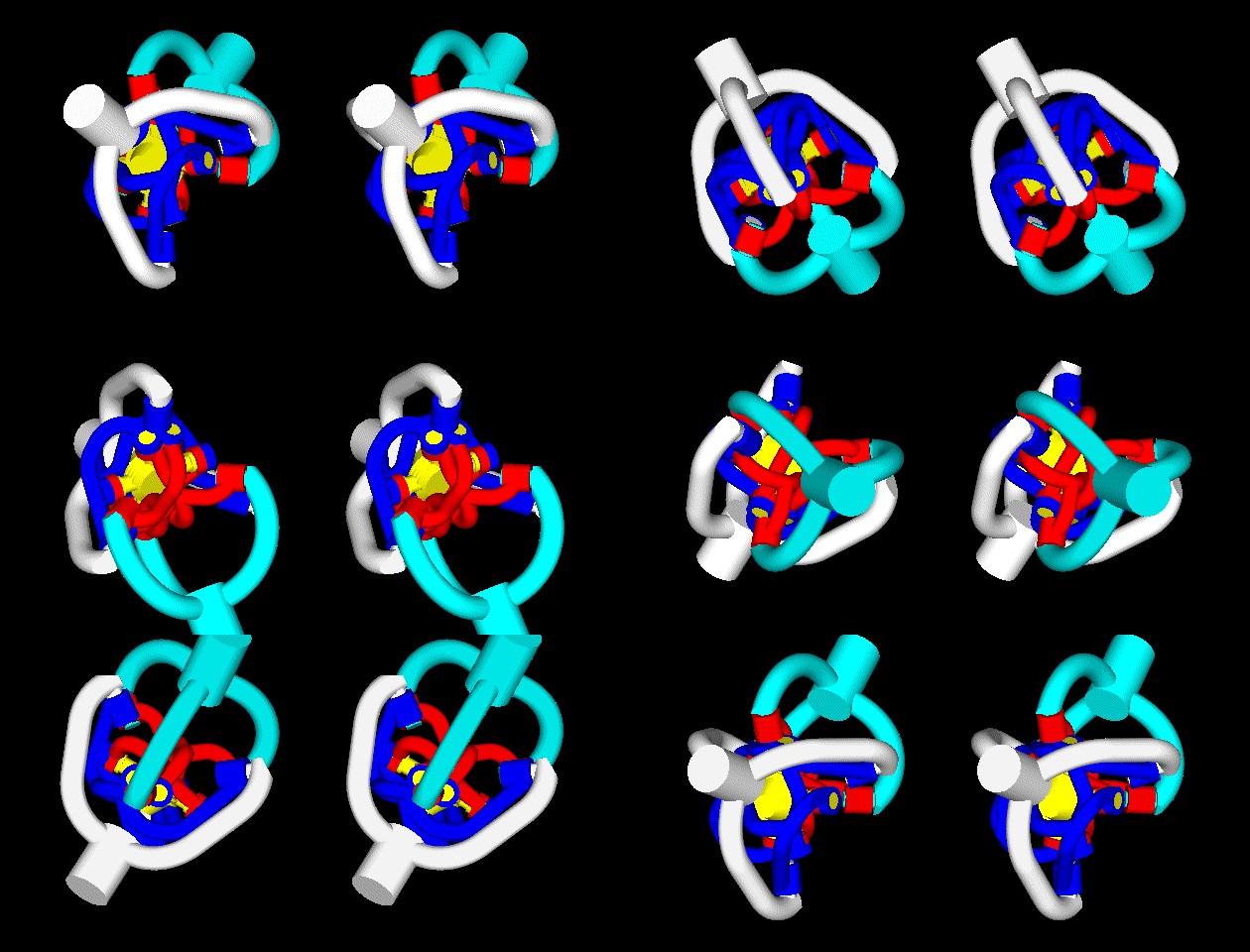
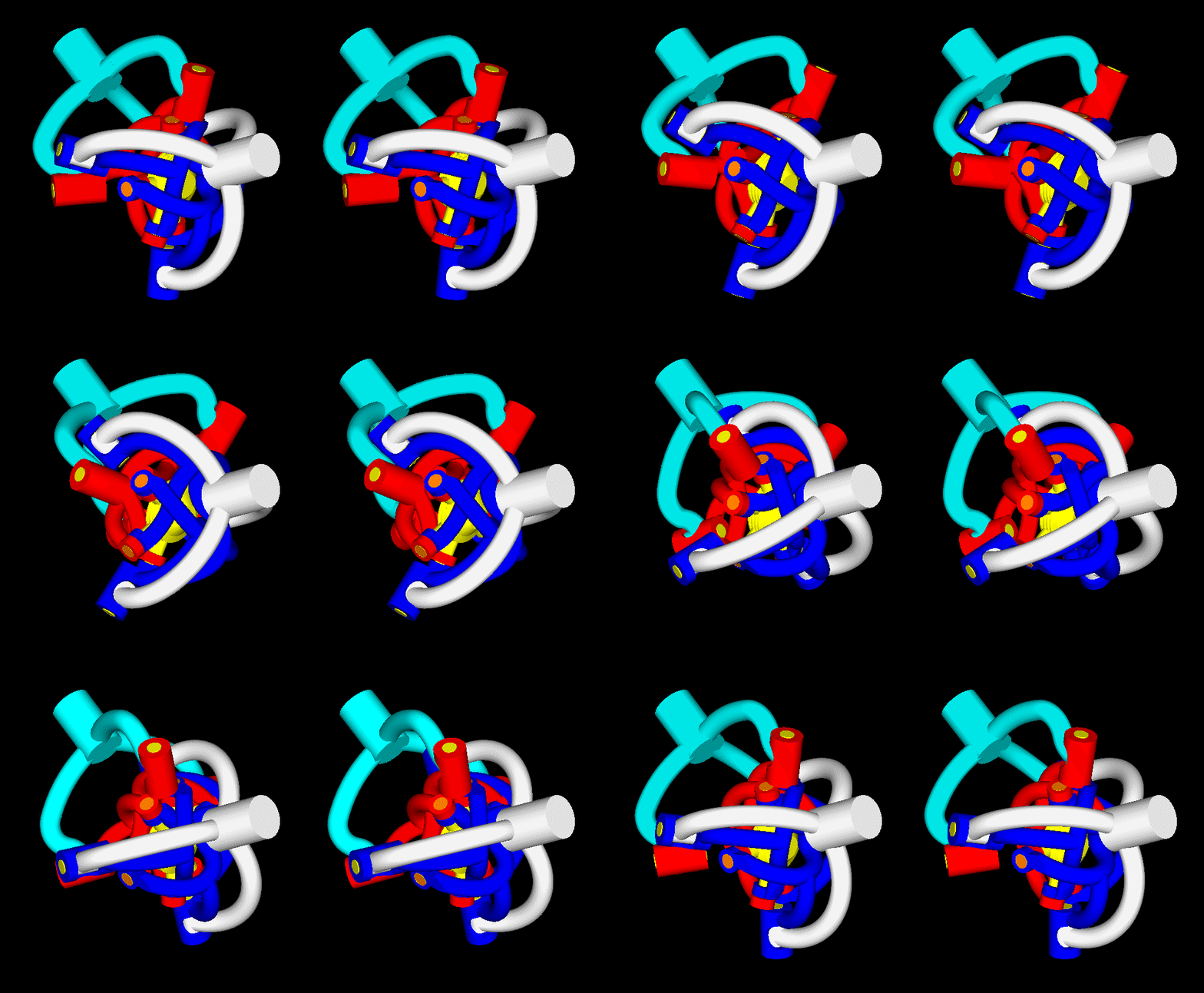
From various viewpoints (60 degrees angle between the shafts):
At -60, -40, -20, 0, +20, +40 and +60 degrees angle between the shafts:
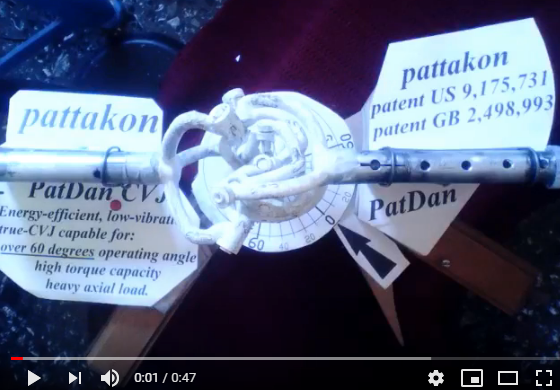
Click on the following images for youtube videos of a demo prototype:
More animations
Click on the above image to download the PatCVJ11.exe
animation (4 MB)
Click on the above image to download the PatCVJ3.exe
animation (3 MB)
Click on the above image to download the PatCVJ6.exe
animation (6 MB)
Click on the above image to download the controllable
windows "exe" stereoscopic animation (7 MB)
Click on the above image to download the controllable
windows "exe" stereoscopic animation (1.8 MB)
Click on the above image to download the controllable
windows "exe" stereoscopic animation (1.3 MB)
Click on the above image to download the controllable
windows "exe" stereoscopic animation (1.3 MB)
Click on the above image (stereoscopic GIF animation).
Robust shafts details. Click for a stereoscopic view.
Peripheral roller bearings. Click to enlarge.
Peripheral roller bearings details. Click to enlarge.
Central triad of yokes. Click to enlarge.
Thrust and needle roller bearings. Click to enlarge.